Quantum computing has long captured the imagination of scientists and technologists with its promise of solving problems beyond the reach of today’s most powerful supercomputers.
But as governments and businesses pour billions into the emerging field, one message is becoming increasingly clear: the future of quantum computing won’t be quantum alone.
Technology company AMD believes the next chapter of quantum innovation will be built on a hybrid approach, where quantum processors work alongside classical computing technologies such as CPUs, GPUs, field-programmable gate arrays (FPGAs), and artificial intelligence.
Rather than replacing conventional computers, quantum systems are expected to serve as specialized accelerators, tackling highly complex calculations while relying on classical infrastructure to manage everything from system control and data preparation to error correction and post-processing.
The shift comes as interest in quantum computing continues to accelerate worldwide. In May, the U.S. Department of Commerce announced plans to invest more than US$2 billion in quantum computing and quantum manufacturing initiatives, underscoring growing confidence that the technology is moving closer to practical, real-world applications.
Potential use cases range from developing new medicines and advanced materials to improving energy research, logistics optimization, and scientific simulations that would otherwise take traditional computers years to complete.
Yet despite its promise, today’s quantum hardware still faces significant technical hurdles, including high error rates, limited stability, and challenges in scaling systems to commercially viable levels.
AMD backs quantum through hybrid computing infrastructure
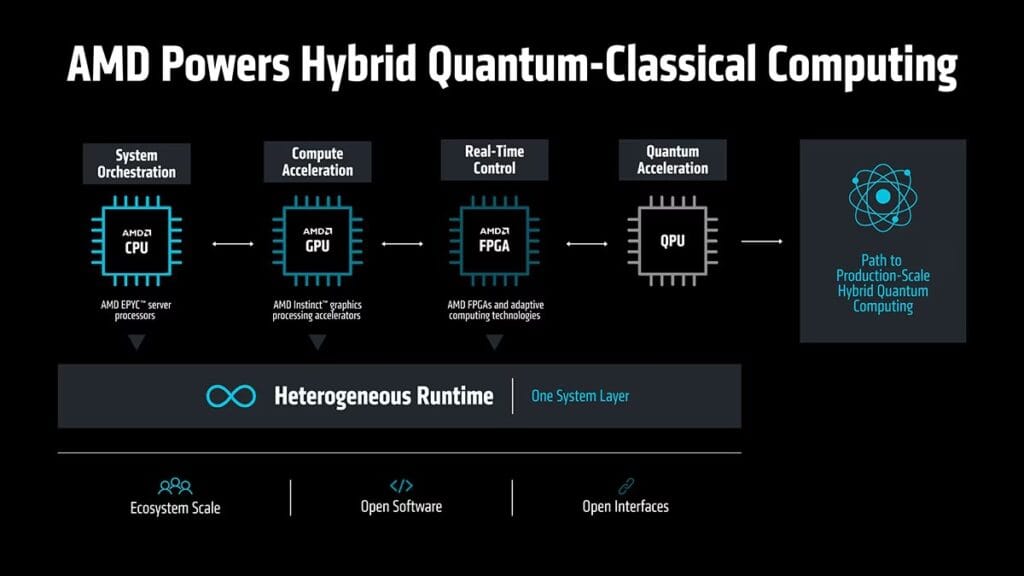
IMAGE CREDIT: AMD
That reality, AMD says, makes classical computing more important — not less.
“The future is increasingly centered on hybrid quantum-classical computing,” the company said, describing a model where different types of processors each perform the tasks they handle best. It’s a concept already familiar in high-performance computing, where CPUs and GPUs divide workloads according to their strengths.
AMD says its portfolio of EPYC server processors, Instinct GPU accelerators, adaptive computing technologies, networking solutions, and open software platforms provides much of the classical foundation needed to operate and scale future quantum systems.
The company is also positioning itself as a technology partner rather than backing a single quantum architecture.
Different approaches to quantum computing — including superconducting, trapped-ion, neutral-atom, and photonic systems — require different control and integration methods, but all rely heavily on robust classical infrastructure.
That strategy has led AMD to collaborate with organizations including IBM, JPMorganChase, and Oak Ridge National Laboratory to explore how quantum systems can work alongside artificial intelligence and high-performance computing.
Multiple technologies unite to power quantum’s future

IMAGE CREDIT: AMD
The partnerships reflect a broader industry trend toward collaboration, where advances in quantum computing depend as much on software, networking, and systems integration as they do on breakthroughs in quantum processors themselves.
For consumers, practical quantum computing may still be years away.
But behind the scenes, companies are already laying the groundwork for an era where quantum and classical computers complement one another rather than compete.
If that vision becomes reality, tomorrow’s biggest scientific discoveries may not come from quantum computers working alone, but from intelligent systems where multiple computing technologies collaborate to solve problems once thought impossible.