An AI trip planner can build a Philippine vacation in seconds. Give it your dates, budget and preferred destination, and it can suggest where to stay, what to eat, which attractions to visit and even what order to do everything in.
That sounds particularly appealing when planning a trip in the Philippines, where a seemingly simple vacation can involve flights, ferries, vans, tricycles, hotel transfers and weather-dependent activities.
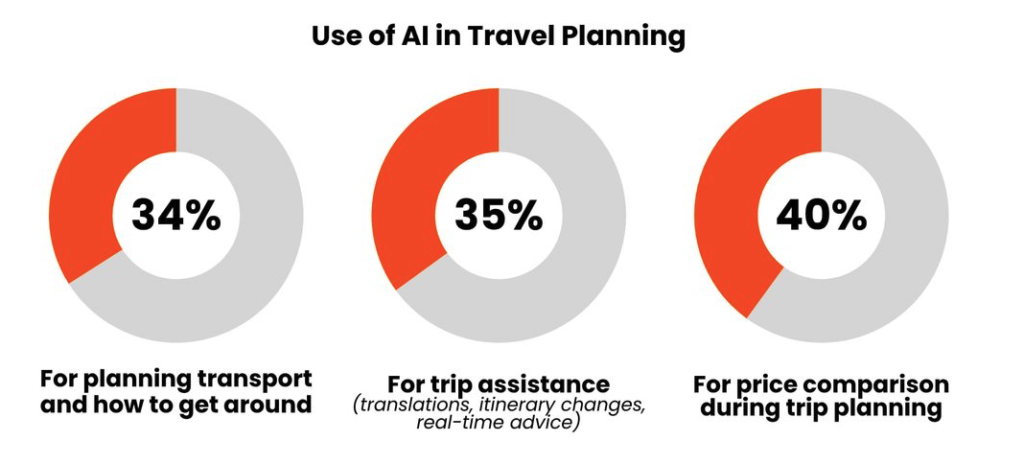
And travelers are already experimenting with it. According to Klook’s Travel Pulse 2026, 94 percent of surveyed Asia-Pacific travelers have used or are open to using AI for travel planning, while 57 percent have already used it to discover destinations or experiences.
But can you actually hand over your entire Philippine vacation to an algorithm?
Not quite.
AI can be an excellent travel assistant. The better way to use it is knowing which parts of the trip it should handle and which decisions still deserve a human double-check.
AI is very good at getting you past the blank page
The hardest part of planning a vacation is sometimes simply figuring out where to begin.
Say you have four days, a ₱20,000 budget and want somewhere outside Metro Manila with good food, nature and enough downtime to avoid returning home exhausted.
An AI tool can immediately turn those requirements into possibilities.
You can make the prompt even more specific:
“Plan a three-day trip to Iloilo for two people. We like heritage sites and local food, don’t want to start before 9 a.m., and want to keep activities below ₱5,000 excluding flights and hotel.”
That is much more useful than typing “things to do in Iloilo” and opening 15 tabs.
VIDEO CREDIT: Gemini
Travel-focused AI tools are also becoming more capable of bringing different parts of trip planning together. Google says Gemini can use information from Maps, Flights and Hotels to help build personalized itineraries, while its AI-powered travel tools can organize flights, hotels, restaurants and attractions around a traveler’s preferences.
For brainstorming and organizing scattered ideas, AI’s biggest advantage is simple: speed.
Let AI solve the itinerary puzzle
AI becomes especially useful when you already know where you want to go but cannot figure out how everything should fit together.
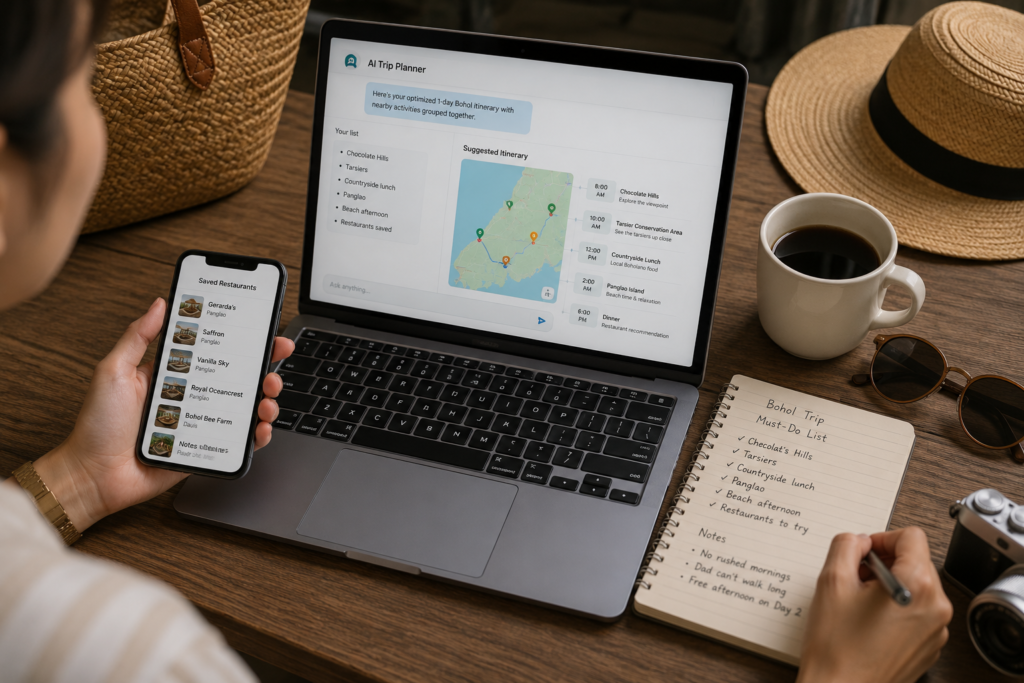
Suppose your Bohol list includes the Chocolate Hills, tarsiers, a countryside lunch, Panglao, a beach afternoon and several restaurants you saved from social media.
Dump the list into an AI tool and ask it to group nearby activities together.
That can save you from accidentally planning breakfast in Panglao, lunch near the Chocolate Hills, an afternoon back at the beach and dinner somewhere inland.
The same approach works particularly well for cities.
In Manila, Cebu or Iloilo, ask AI to group restaurants, museums, cafés and attractions geographically rather than simply producing a list of the “top 10 things to do.”
You can also tell it how you actually travel.
If your family dislikes rushed mornings, say so. If someone cannot walk long distances, include it. If you want one free afternoon with absolutely nothing scheduled, tell the AI not to fill it.
A generic prompt produces a generic vacation. Specific constraints are what make an AI itinerary useful.
But never assume the itinerary is correct
This is where the human planner needs to return.
An AI-generated itinerary can look convincing while still containing information that needs checking. A restaurant may have changed its operating hours. An attraction may be closed on your chosen day. A transfer that looks manageable on paper might be unrealistic once Philippine traffic enters the equation.
That becomes even more important when transportation is involved.
A ferry may have limited departures. A van might leave based on passenger demand. An island-hopping tour can depend on sea conditions. A road that looks short on a map might take considerably longer during peak traffic.
Then there is the weather.
A beautiful itinerary for Siargao, Palawan or Batanes becomes considerably less useful when conditions suddenly change.
Before treating any AI-generated plan as final, verify the details that could ruin the day: opening hours, ticket prices, ferry schedules, travel times, tour availability and weather conditions.
For restaurants and attractions, check the establishment’s official page or recent listings. For transportation, go directly to the operator whenever possible.
AI should create the draft. Current information should approve it.
Use it to find possibilities, not make every decision
AI is also becoming a discovery tool.
Klook’s 2026 research found that 57 percent of surveyed APAC travelers had already used AI to discover destinations or experiences, with 36 percent going on to book something they found through it.
But there is an important catch.
When travelers were asked which sources they trusted when actually making decisions, verified reviews ranked first at 58 percent, compared with 33 percent for AI suggestions.
That is a useful rule to borrow for your own trip.

Ask an AI trip planner for “quiet beaches near Cebu” or “heritage towns within driving distance of Manila,” and it might surface somewhere you had not considered.
Then investigate it yourself.
Check recent traveler photos. Read recent reviews. Look at the destination on Maps. Search for what visitors are currently saying about the experience instead of relying entirely on the AI’s description.
The same applies to restaurants.
An algorithm can help build a shortlist. It cannot guarantee that the tiny carinderia your local driver recommends will not end up serving the best meal of your trip.
Some discoveries still happen because you asked a person.
AI is surprisingly useful for the boring parts
You do not have to let AI choose your destination for it to make traveling easier.
Give it your finalized itinerary and ask for a packing checklist based on the activities. Ask it to create a daily budget. Have it organize reservation details into one schedule.
It can turn a chaotic group chat into a cleaner itinerary or divide expected expenses into categories so everyone knows approximately how much to prepare.
You can even ask:
“What could go wrong with this itinerary?”
That is sometimes more useful than asking AI to build the itinerary itself.
It may spot a connection that looks too tight, an overly ambitious day or a section where you have not allowed enough time for transportation.
Think of AI as the extremely organized friend who enjoys making spreadsheets but does not get the final vote.
Do not give AI information it does not need
Convenience should not mean handing an AI tool every detail about your trip.
There is usually no reason to paste passport numbers, complete booking credentials, payment information or other sensitive personal data into a chatbot simply to organize an itinerary.
Give it what is useful.

IMAGE CREDIT: Freepik
Travel dates, approximate budget, general accommodation area, interests, dietary preferences and activity limitations can all improve an itinerary without revealing information the tool does not need.
The same applies when traveling with other people. Avoid entering someone else’s sensitive information just because you are the designated trip planner.
Leave some room for the trip to go wrong
There is also a point where optimizing a vacation too much can make it less enjoyable.
AI can theoretically schedule your breakfast, museum visit, café stop, lunch, afternoon activity, sunset viewpoint and dinner reservation down to the hour.
That does not mean you should.
A Philippine vacation will not always cooperate with a perfect schedule.
Traffic happens. Rain arrives. Someone gets tired. Lunch takes longer than expected. You discover another place you would rather visit.
Build breathing room into the itinerary.
A free morning or unscheduled afternoon is not wasted time. It gives you somewhere to put the experiences you did not know existed when you first made the plan.
The best travel planner may actually be you plus AI
AI travel planning is quickly moving beyond novelty. Google reported in April 2026 that search interest in “AI travel assistant” and “AI concierge” had grown 350 percent over the previous year, while searches related to AI flight booking were also rising sharply.
That does not mean algorithms are ready to take over your vacation.
Philippine travel is full of variables that cannot always be flattened into a perfect itinerary.
Sometimes the ferry is delayed. Sometimes your driver knows a better restaurant. Sometimes the beach is so good that you decide to cancel everything scheduled for the afternoon.
And sometimes that change of plan becomes the best part of the trip.
So can an AI trip planner organize your next Philippine vacation better than you can?
Possibly.
Let it handle the research, sequencing, brainstorming and repetitive work. You should still make the choices, verify what matters and leave enough space for the trip to surprise you.
After all, the goal is not to create the most optimized itinerary possible.
It is to have a vacation you actually enjoy.