
For years, a college diploma has been the primary ticket to employment. Today, however, employers are increasingly looking for something more: proof that graduates possess practical, job-ready skills.
A new report from online learning platform Coursera suggests that micro-credentials — short, industry-recognized certifications that validate specific competencies—are becoming a valuable advantage for Filipino job seekers.
According to the company’s Micro-Credentials Impact Report 2026, nearly nine in ten employers in the Philippines are now willing to offer higher starting salaries to graduates who possess these credentials.
The study found that 89% of Filipino employers are prepared to pay more to graduates with micro-credentials, while 36% said they would offer salary increases of more than 15% to candidates who have earned credentials in generative artificial intelligence (GenAI).
The findings come as businesses across industries continue to adopt AI and digital technologies, placing greater emphasis on practical skills that allow new hires to contribute immediately.
“As AI reshapes the workplace, employers are placing a premium on candidates who can prove they have practical, job-ready skills,” said Ashutosh Gupta, Managing Director for Asia Pacific at Coursera.
“In the Philippines, micro-credentials are no longer just a differentiator—they are becoming an essential signal of employability.”
Skills-first hiring gains momentum
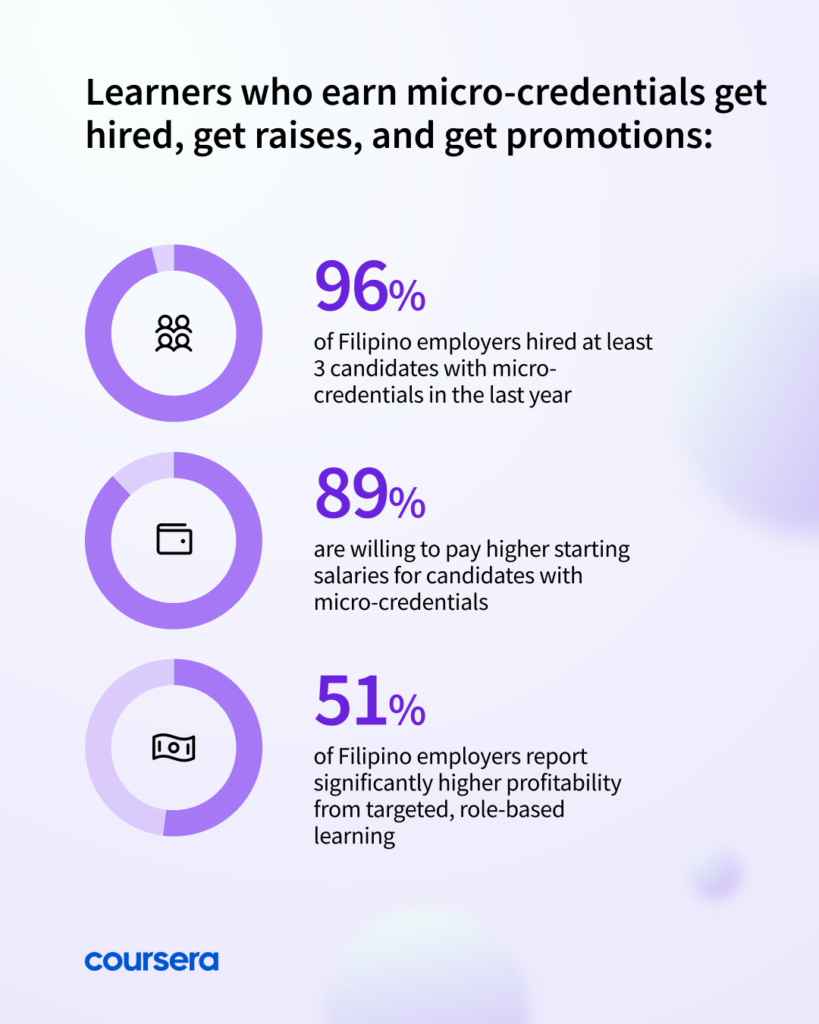
IMAGE CREDIT: Coursera
Coursera‘s report points to a growing shift toward skills-first hiring in the Philippines.
Among employers surveyed, 96% said they hired at least three candidates with micro-credentials over the past year. Meanwhile, 90% reported that entry-level employees with these credentials performed better during their first year on the job.
The study also found that 77% of employers said applicants with micro-credentials moved more quickly through the hiring process than those without them.
The report draws on responses from more than 3,500 employers, learners, and higher education leaders across seven countries, including the Philippines.
AI economy drives demand for new skills
The increasing value placed on micro-credentials coincides with the country’s broader push to prepare its workforce for an AI-powered economy.
According to Google, artificial intelligence could generate an estimated US$50.7 billion in productivity gains and cost savings for the Philippines by 2030. Realizing that potential, however, will depend on developing workers with relevant digital and technical skills.
The Philippine government has also begun laying the groundwork for this transition.
In 2025, the Commission on Higher Education (CHED) issued Commission Memorandum Order No. 1, establishing a national framework for industry-aligned and stackable micro-credentials. The policy enables higher education institutions to integrate recognized certifications into degree programs, allowing students to earn credentials that can be accumulated throughout their academic journey.
Gupta said the policy represents a significant step toward strengthening collaboration between universities and industry.
“The data shows strong alignment between employers, students, and higher education leaders,” he said. “Learners want credentials that count toward degrees, employers are willing to pay more for them, and universities see them as critical to staying relevant.”
Students now value industry-recognized credentials
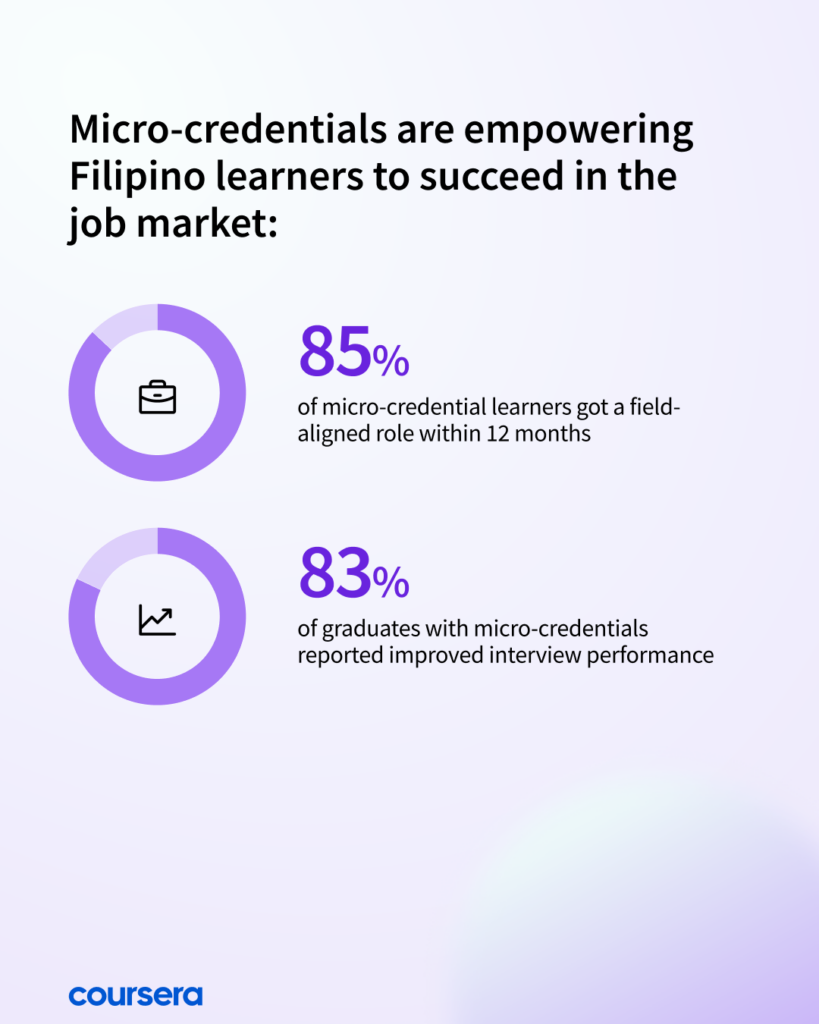
IMAGE CREDIT: Coursera
The report also found that students are becoming more selective when choosing universities.
Nearly 79% of Filipino students said they would pursue micro-credentials if these counted toward academic credit — more than four times the proportion willing to take them without formal recognition.
Meanwhile, 62% viewed industry-created credentials that contribute to a degree as the strongest indicator of educational quality.
The study further reported that 85% of graduates who earned micro-credentials secured employment related to their field of study within 12 months of graduation.
Universities adapt to changing workforce demands
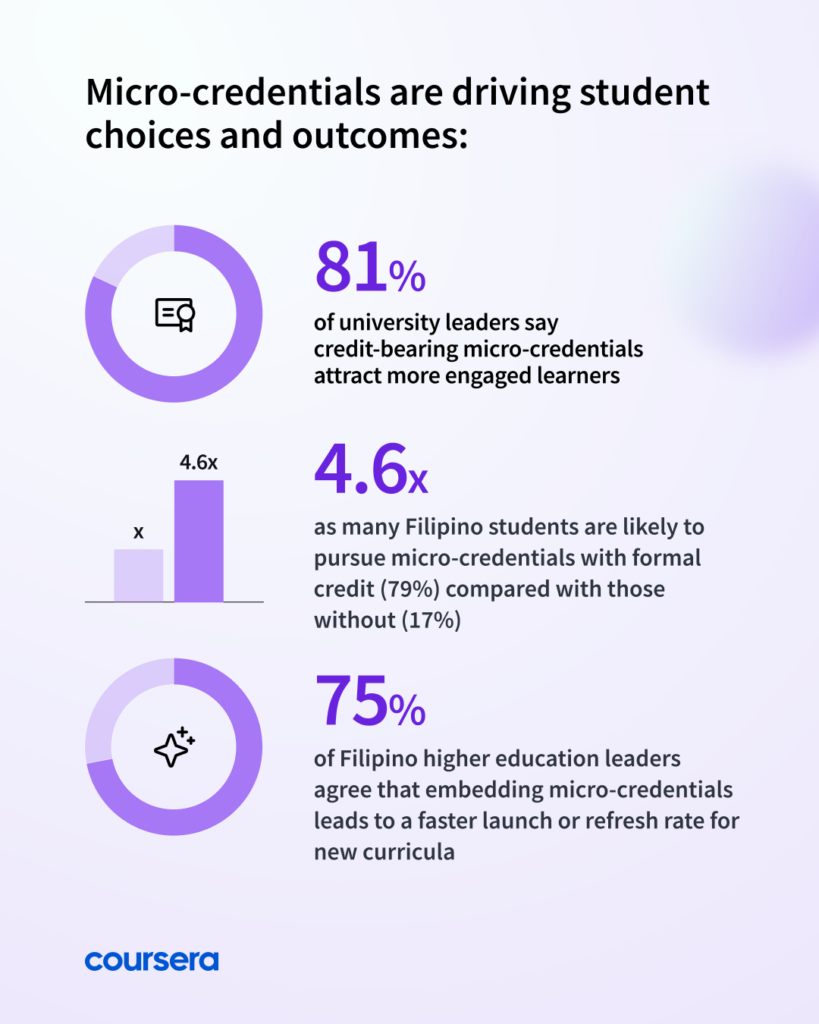
IMAGE CREDIT: Coursera
Higher education institutions are also responding to the evolving expectations of employers.
Among academic leaders surveyed, 86% said embedding micro-credentials into degree programs helps bridge classroom learning with workforce needs. Three out of four institutions also reported improved student retention and faster curriculum updates after integrating industry-recognized certifications.
One of the institutions expanding its use of micro-credentials is iPeople Inc., which has incorporated more than 50 Professional Certificates across schools under the Mapúa Education Group, including Mapúa University campuses in Manila, Laguna, and Mindanao, the National Teachers College, the University of Nueva Caceres, and Mapúa Malayan Digital College.
“Our graduates are talented, but talent alone doesn’t win in a global job market — proof of skills does,” said Dr. Dodjie Maestrecampo, President and CEO of Mapúa Education Group.
“Micro-credentials embedded into a degree give Filipino students industry-recognized, globally credible evidence of what they can deliver from day one.”
As AI continues to transform workplaces and employers increasingly prioritize demonstrable skills, micro-credentials appear poised to become a more prominent feature of Philippine higher education — offering graduates another way to stand out in an increasingly competitive job market.