The Moriones Festival in Marinduque is more than just a spectacle of colorful masks and Roman-inspired costumes: it is a profound expression of faith, identity, and community rooted in the island province of Marinduque.
Held during Holy Week, the Moriones Festival transforms quiet towns into living theaters, where locals and visitors alike witness a unique blend of religious devotion and cultural storytelling.
At its heart lies the story of Longinus, the Roman centurion whose journey from doubt to belief mirrors the deeper spiritual meaning of the season.

The Moriones Festival in Marinduque. (IMAGE CREDIT: Weebly)
The origins of the Moriones Festival
The Moriones Festival is a vibrant Holy Week tradition held on the island province of Marinduque, where faith and folklore come together in a week-long celebration.
During the Moriones Festival, participants wear intricately designed masks and costumes inspired by Roman soldiers, transforming the streets into a living stage of devotion and storytelling.
These masked figures, known as Morions, roam towns reenacting scenes that reflect both biblical history and local culture.

IMAGE CREDIT: Tourism Promotions Board
At the core of the Moriones Festival is the story of Longinus, the Roman centurion who pierced the side of the crucified Christ.
According to tradition, Longinus was blind in one eye, but when Christ’s blood touched it, he miraculously regained his sight. This life-changing moment led to his conversion to Christianity, prompting him to proclaim his newfound faith despite the danger it posed.
Throughout the festival, Morions symbolically search for Longinus, leading to the dramatic climax known as the pugutan, or his capture and execution.

Longinus, the Roman soldier. (IMAGE CREDIT: desperado.cz)
Rooted deeply in Marinduque’s history, the Moriones Festival dates back to the Spanish colonial period, with influences from Catholic teachings and local interpretations of faith.
The term “morion” comes from the Spanish word for helmet, reflecting the iconic masks worn during the event. The festival is celebrated across several towns, including Boac, Mogpog, Gasan, Santa Cruz, Buenavista, and Torrijos, each adding its own flavor to the tradition.
Central to the Moriones Festival is the concept of “panata” — a vow or act of devotion — where participants endure physical challenges and embody roles as a form of sacrifice, repentance, or gratitude.

Marinduque on a Holy Week. (IMAGE CREDIT: Shutterstock)
Beyond its religious roots, the Moriones Festival has evolved into a powerful cultural showcase. With its mix of live performances, processions, and dramatic reenactments, it highlights the creativity and resilience of the Marinduqueños.
Today, the Moriones Festival stands as a compelling fusion of spirituality, history, and artistic expression, drawing visitors from around the world to witness one of the Philippines’ most distinctive cultural traditions.
Masks, costumes, and cultural expression
One of the most striking elements of the Moriones Festival is its iconic masks. Crafted from wood, papier-mâché, or fiberglass, each mask is a unique work of art, often depicting fierce, exaggerated Roman faces.
These masks are not merely decorative — they serve as a powerful representation of anonymity, allowing participants to embody the role of Roman soldiers while reflecting on their own personal journeys of faith.
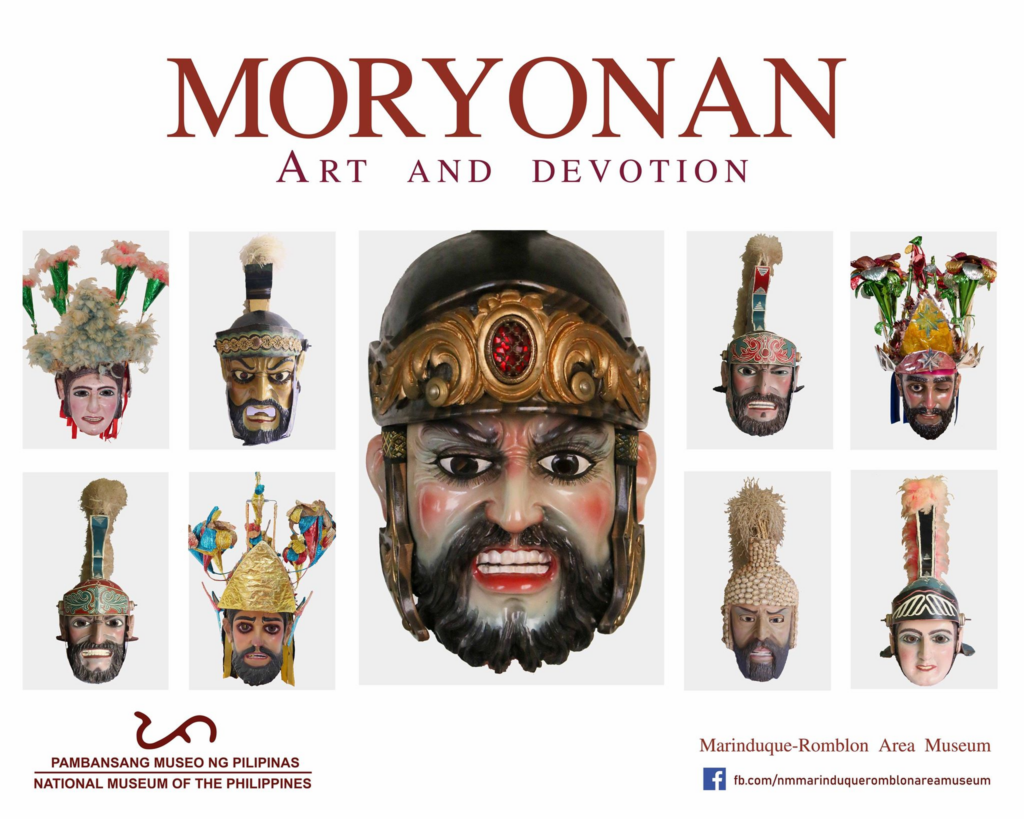
Poster by MYR Frias, text by AS Alvarez (IMAGE CREDIT: #NationalMuseumPH)
Beyond the masks, the costumes themselves are vibrant and theatrical, complete with capes, armor, and props that bring the streets of Marinduque to life.
Participants, known as “Morions,” roam the towns, interacting with crowds and performing improvised scenes.
This immersive experience blurs the line between performer and observer, inviting everyone to become part of the Moriones Festival narrative.
Moriones Festival highlights
The Moriones Festival comes alive through a series of vibrant and meaningful activities that blend faith, performance, and community participation.
Throughout Holy Week, “Morions” in striking masks and Roman-inspired attire fill the streets, reenacting the story of Longinus while engaging crowds through parades, street performances, and theatrical displays.
Each municipality in Marinduque follows its own schedule, adding variety and richness to the overall Moriones Festival experience.
One of the most anticipated traditions is the Harana ng Morion, held on Black Saturday.
Morions visit homes, shops, and establishments, performing rhythmic music using the kalutang — a native wooden percussion instrument. In return, they receive small donations, which often help cover the costs of their elaborate costumes and participation.
This practice reflects both creativity and practicality, rooted in long-standing local customs.
Religious devotion is central to the Moriones Festival, particularly through the Pasyon, a continuous chanting or reading of Christ’s life, suffering, death, and resurrection. This sacred recitation often lasts for hours, with leaders taking turns to sustain the flow of prayer.
Complementing this is the Senakulo, a dramatic retelling of the Passion of Christ staged over several nights, especially in Boac. Actors perform through expressive movement while narration guides the story, creating a powerful and immersive experience for audiences.
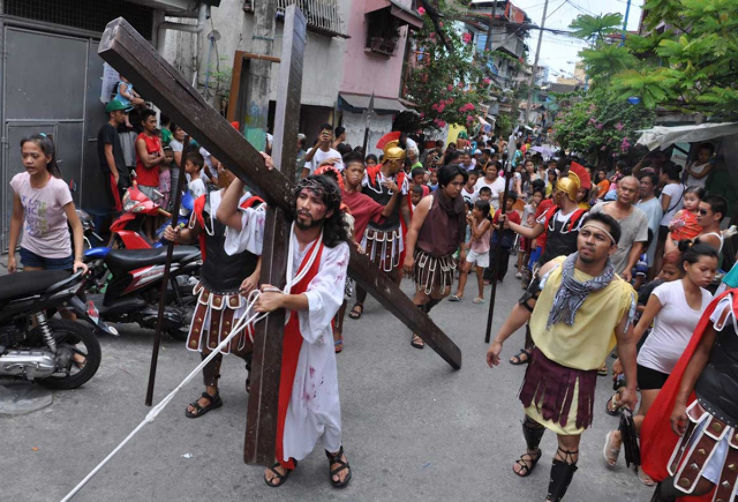
The festival reaches a dramatic peak with the Pugotan, or the reenactment of Longinus’ story.
After witnessing the miracle of healing, Longinus becomes a believer, only to be pursued and ultimately executed.
This intense sequence includes a city-wide chase, where Morions attempt to capture him, culminating in his symbolic beheading. It is one of the most gripping moments of the Moriones Festival, drawing large crowds each year.
On Easter Sunday, the mood shifts to celebration with the Salubong, marking the meeting of the risen Christ and the Virgin Mary. A highlight of this event is the ceremonial lifting of Mary’s veil, symbolizing the end of her sorrow.
The festival concludes with joy and hope, reinforced by traditions like the Putong, a welcoming ritual involving song, dance, and the crowning of guests with handmade headpieces, accompanied by cheers of “Mabuhay!”
Another significant observance is the Via Crucis, a solemn reenactment of the Stations of the Cross held on Good Friday. Participants, often as an act of sacrifice and devotion, portray scenes from Christ’s suffering, including the crucifixion and burial.
Morions play a role here as well, guiding and sometimes dramatizing the journey to Calvary, further enriching the spiritual depth of the Moriones Festival.
Faith, community, and modern Identity

While the Moriones Festival is deeply rooted in religious tradition, it also serves as a powerful expression of community identity. Families pass down the art of mask-making through generations, ensuring that the craft and its meaning endure.
For many locals, participating in the festival is both a spiritual commitment and a cultural responsibility.
In recent years, the Moriones Festival has gained attention from tourists and cultural enthusiasts, adding a new dimension to its significance.
Despite modernization, the festival remains grounded in its original purpose, commemorating Holy Week through devotion and storytelling. It stands as a testament to how tradition can evolve while preserving its essence, bridging the past and present in meaningful ways.
Behind the masks of Morions in Moriones Festival
The Moriones Festival is not just an event, it is a living tradition that captures the soul of Marinduque. Through its vivid masks, compelling narratives, and unwavering faith, it invites reflection on identity, belief, and transformation.
In every carved detail and every reenacted scene, the Moriones Festival reminds us that behind every mask lies a story, one of heritage, humanity, and hope.