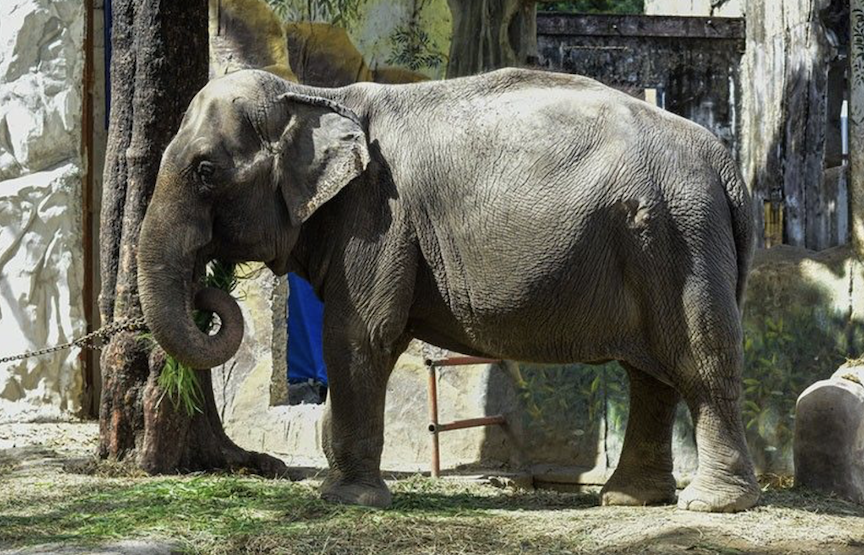
For generations of Filipinos, Mali was simply the elephant at Manila Zoo.
Children grew up seeing her standing inside the enclosure. Parents brought their kids to meet her. School trips passed by her habitat. For many visitors, she was one of the first, and perhaps only, elephants they would ever see in person.
But behind that familiar attraction was a much more complicated story.
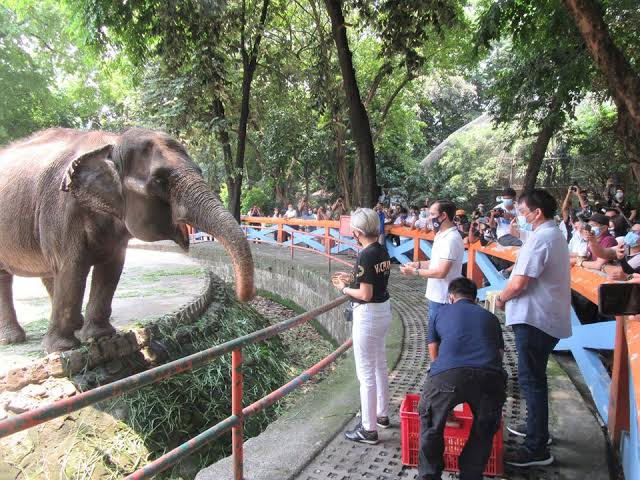
IMAGE CREDIT: Getaway.PH
Mali was brought to the Philippines from Sri Lanka in 1977 when she was only around 11 months old. Instead of growing up in a herd in the wild, she spent the rest of her life at Manila Zoo, becoming a fixture of the city’s landscape and a familiar face to generations of visitors.
She died in 2023 at around 43 years old.
For some Filipinos, that should have been the end of a painful chapter.
Instead, Mali has appeared again, this time inside a museum.
And that is why the words “Let Mali Rest” are once again being heard.
From baby elephant to Manila Zoo attraction
Mali’s story began when she was brought to Manila as a young elephant and eventually became the zoo’s most recognizable resident.

Mali, the elephant. (IMAGE CREDIT: EFE)
For decades, visitors encountered her in the same enclosure. What looked to children like an exciting opportunity to see an elephant up close was, to animal welfare advocates, a troubling picture of an animal living in captivity without the social and environmental conditions elephants naturally experience.
Mali also spent most of her life without another elephant companion.
Her companion Shiva, another female elephant, died in 1990. Mali was subsequently left alone for more than three decades.
That detail has remained one of the most painful parts of her story.
Elephants are highly social animals that naturally live in family groups and maintain complex social relationships. Mali, meanwhile, became increasingly associated with a solitary existence inside a zoo enclosure.
Why Mali became known as the “world’s saddest elephant”
Aside from being sad (alone), Mali’s physical condition also became a major concern for animal rights organizations.
Animal welfare advocates had raised concerns about foot problems, skin conditions, her weight and the limited stimulation available to her. Her repetitive movements and long periods of standing became part of the public discussion surrounding her welfare.
Organizations including People for the Ethical Treatment of Animals (PETA) had repeatedly campaigned for Mali to be transferred to an elephant sanctuary in Thailand.
The proposed move was controversial at the time, with Philippine officials and zoo authorities maintaining their own positions about Mali’s care and whether transferring her would be appropriate.
But the debate never really disappeared.
For years, Mali remained where she was.
And for years, people continued visiting her.
Children see an attraction, adults see a different story
That contrast is perhaps what makes Mali’s story particularly complicated.
A child walking into Manila Zoo might have seen something extraordinary: a real elephant standing only a few meters away.

There was excitement. There were photographs. There were children waving at her.
But an adult looking at the same enclosure could see something else: an enormous animal living on concrete, largely alone, in an environment dramatically different from the forests and social groups elephants evolved to inhabit.
That difference between what an attraction means to a child and what captivity can mean to an animal is at the heart of the debate surrounding Mali.
For many Filipinos who remember visiting her, there is affection.
But affection does not necessarily erase the uncomfortable questions about how she lived.
Mali died, but the debate didn’t
When Mali died in November 2023, many people expected her story to finally come to an end.
Instead, her remains were preserved.
Her taxidermied body has now been displayed at the National Museum of Natural History, turning Mali from a living attraction into a museum specimen.
Taxidermied body of Mali
The decision has prompted criticism from Filipinos who believe that, after decades of captivity and public display, Mali deserves something other than another lifetime—or afterlife—on exhibition.
The reaction has been particularly emotional because of what Mali represented.
She was not simply an elephant.
She was part of people’s childhoods.
What does it mean to “Let Mali Rest”?
The phrase “Let Mali Rest” captures the emotional argument behind the backlash.
For those calling for her burial, the issue is not simply whether taxidermy is appropriate in a museum.
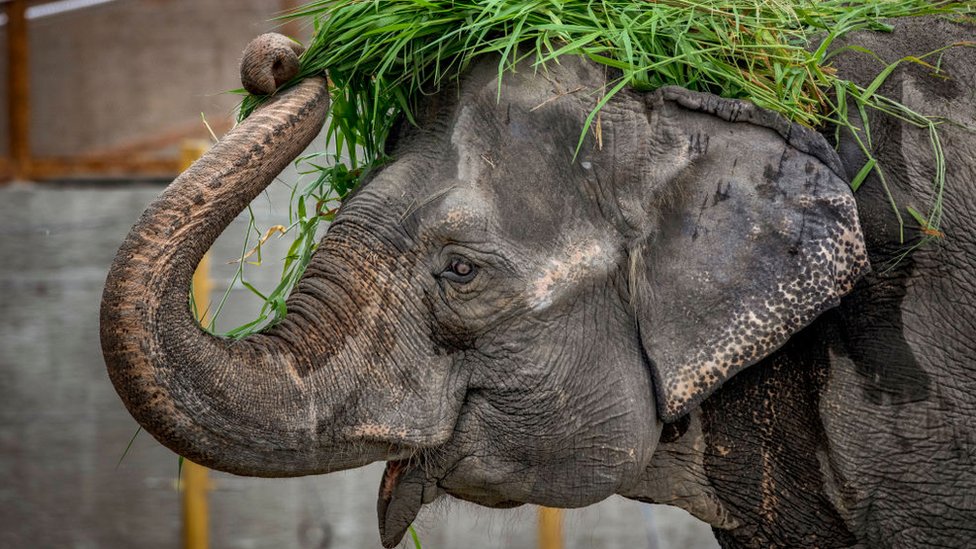
It is about dignity.
Mali spent approximately 46 years being viewed by the public. Her enclosure was one of the places visitors expected to see when they went to Manila Zoo.
Now, even after death, she is once again being placed behind the gaze of the public.
That is what some Filipinos find deeply uncomfortable.
If Mali’s life was already defined by captivity and public display, why should death not finally give her the privacy she never had?
Museums can preserve history, not everyone agrees how
There is a legitimate educational argument for preserving animal specimens.
Natural history museums exist to help people understand biodiversity, anatomy, evolution and the natural world. Taxidermied specimens can allow future generations to study animals they might otherwise never encounter.

But Mali’s situation is different from that of an animal collected as a scientific specimen.
She was a known individual. People knew her name and they watched her for decades.
They remember her personality, her appearance and her enclosure.
For many visitors, Mali was not an anonymous example of Elephas maximus.
She was Mali.
That personal connection changes the emotional weight of displaying her remains.
The question of dignity
There is also a broader question here about how society treats animals once they stop being useful to us.
During her lifetime, Mali served as an attraction.
She brought visitors to Manila Zoo and became part of the city’s cultural memory.
After her death, her body has continued to serve an educational and cultural purpose.
But should an animal have to remain useful even after it dies?
That is the question behind much of the criticism.
Humans decide where animals live, whether they are displayed, how they are cared for and what happens to their bodies after death.
Mali had no say in any of those decisions.
Remembering Mali doesn’t have to mean displaying her
There is another way to remember her.
Mali could be commemorated through photographs, educational materials, a memorial, a sculpture or a permanent exhibit telling the story of her life and the evolving understanding of elephant welfare.
Her story could teach future generations about the realities of captivity, the importance of social environments for elephants and the responsibilities humans have when keeping wild animals.
In that sense, Mali’s legacy could be more meaningful if people remember the elephant she was, rather than simply looking at what remains of her body.
A memorial could acknowledge both the affection Filipinos developed for her and the suffering that animal welfare advocates believe she experienced.
Mali’s story is bigger than one elephant
The debate surrounding Mali reflects a much larger conversation about zoos and wildlife conservation.
There is a difference between protecting animals, educating the public and keeping wild animals in environments that may not meet their physical, social and psychological needs.
Modern zoos increasingly face questions about enclosure design, enrichment, conservation breeding and whether certain species can thrive in captivity.
Elephants present an especially difficult case because of their enormous space requirements, intelligence, social structures and long lifespans.
Mali’s decades-long story forces Filipinos to ask what we once considered acceptable and whether our understanding of animal welfare has changed.
Perhaps the most important part of her legacy is that the conversation continues.
She was loved, but was she free?
It is possible to hold two feelings at the same time.
Filipinos can love Mali and cherish childhood memories of seeing her.
And they can also recognize that her life may have been profoundly different from what an elephant should experience in the wild.
Those memories do not have to be erased.
If anything, they can become part of the reason people care more deeply about animal welfare today.
The children who once waved at Mali are now adults. Some have children of their own. They can tell the next generation about the elephant they grew up seeing at Manila Zoo, while also explaining why her story became a lesson in compassion.
Let Mali rest
Mali spent most of her life in one place.
She lived behind barriers. She was watched by strangers. She became a fixture of a city that would change dramatically around her.
For decades, people came to see her.
Even after she died, people are still being asked to see her.
Maybe this time, however, the public should be allowed to remember her differently.
Not as a zoo attraction.
Not as a museum specimen.
Not simply as the “world’s saddest elephant.”
But as an individual animal whose life has prompted an entire country to think more seriously about captivity, compassion and the responsibility humans have toward creatures they bring into their care.
Mali spent a lifetime being looked at. Perhaps, finally, she deserves to be left in peace.
Let Mali Rest.