Communications professionals and academics are calling for urgent curriculum reform and job redesignation as artificial intelligence rapidly transforms the public relations and journalism landscape, raising concerns that traditional roles may no longer keep pace with industry demands.
At the 4th FRAMEwork: Asia-Pacific Communication Conference, held on March 26, 2026, industry leaders gathered under the theme “Troubleshooter or Troublemaker: Parameters, Recalibrations, and Trajectories in AI-Aided Communication and New Media” to examine how AI is reshaping media work, from newsroom operations to corporate communications strategy.
Organized by the Far Eastern University – Institute of Arts and Sciences in partnership with regional academic institutions and communication organizations across Asia, the conference brought together practitioners and scholars to explore emerging frameworks in an AI-driven information environment.
‘AI will not replace you. Someone using AI will’

Ana Pista takes the stage at the 4th FRAMEwork Asia-Pacific Communication Conference
Opening the discussion, Ana Pista, APR, the founder and CEO of Ardent Communications, CEO of the AI Centre of Excellence (ACE), and President of the Public Relations Society of the Philippines (PRSP) — highlighted how technological disruption has repeatedly reshaped the communications profession.
Recalling earlier shifts in workplace technology, she said the current wave of AI adoption mirrors past disruptions but moves at a far faster scale.
“It’s a full circle for me — from the launch of Windows 95 that led to workforce disruption, to today with the arrival of AI,” Pista said.
She warned that AI is fundamentally changing how communication teams operate, pointing to emerging trends such as answer engine optimization (AEO), the use of chatbots in internal communications, and “narrative intelligence” systems that track brand reputation in real time.
“AI will not replace you. Someone using AI will,” she stressed, adding that the shift requires not only new skills but also rethinking organizational structures.
From job titles to ‘job personas’

Student participants at the event
Pista also challenged traditional employment structures in communications teams, proposing a shift from fixed job titles to more flexible “job personas” that reflect hybrid skill sets.
“At Ardent Communications, we built a quick-reaction team,” she said. “Our people don’t just report what happened — they predict trends, measure sentiment in real time, and link campaign activity to shifts in brand perception.”
Under this model, professionals are encouraged to evolve beyond static roles. A traditional “PR intern,” for example, could develop into a “story innovator” capable of combining content creation, data analysis, and AI-assisted storytelling across platforms.
She said this redesign is necessary for survival in a rapidly changing communications ecosystem. “The question is no longer what your role is—but how you diversify your skill sets.”
Ethical guardrails for AI in journalism
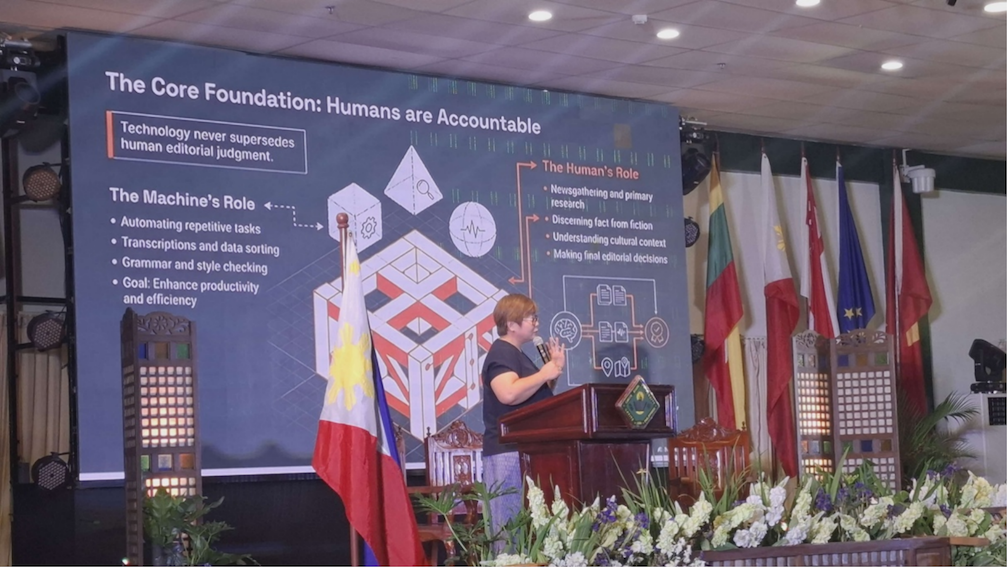
Rappler’s Gemma Mendoza stresses the importance of companies taking accountability.
Providing a newsroom perspective, Gemma Mendoza of Rappler emphasized that while AI offers efficiency gains, it must be deployed with caution and accountability.
“I don’t want to say AI is clearly good,” Mendoza said, noting concerns such as content scraping and the unauthorized use of newsroom material by AI systems.
She outlined how Rappler has integrated AI into its newsroom workflows, including transcription, summarization, and audience engagement tools, while also experimenting with data-driven insights for public interest reporting.
However, she warned that increased automation also introduces risks such as misinformation, manipulation, and overreliance on AI-generated outputs.
“The grounding point here that’s needed, before you start anything, is adopting guardrails,” she said.
Rappler, she added, has implemented internal AI guidelines and continues to refine them as technologies evolve, particularly with the rise of agentic AI systems.
Rethinking communication education

Moderator Renz Alcazar (left), Ana Pista (center), and Gemma Mendoza (right) discussing the effects of artificial intelligence. (IMAGE CREDIT: FEU NewsDotComm)
The panel discussion, moderated by Renz Kevin Alcazar of Cavite State University, also highlighted the widening gap between academic training and industry realities.
Pista noted that most communication graduates eventually enter public relations roles despite the lack of dedicated PR programs in many universities, calling this a structural gap in education.
“We always say that 99% of what you read — whether in social media, print, or online — is PR-generated,” she said. “So, why is PR treated as a ‘unit’ rather than a course?”
Mendoza echoed the need for stronger digital and data literacy in journalism education, stressing that modern reporters must be able to critically evaluate technology, not just use it.
“In this day and age, you cannot be a journalist who doesn’t know how to look at technology through a critical lens or handle data,” she said.
Both speakers agreed that while AI is reshaping the industry, it should remain a tool and not a decision-maker.
Looking ahead
As AI adoption accelerates across communications fields, industry leaders say the challenge is no longer whether the technology will be adopted, but how responsibly and effectively professionals can adapt to it.
The conference concluded with a shared call for collaboration between academe and industry to ensure future communicators are equipped not just with creative skills, but also with technological fluency and ethical grounding.