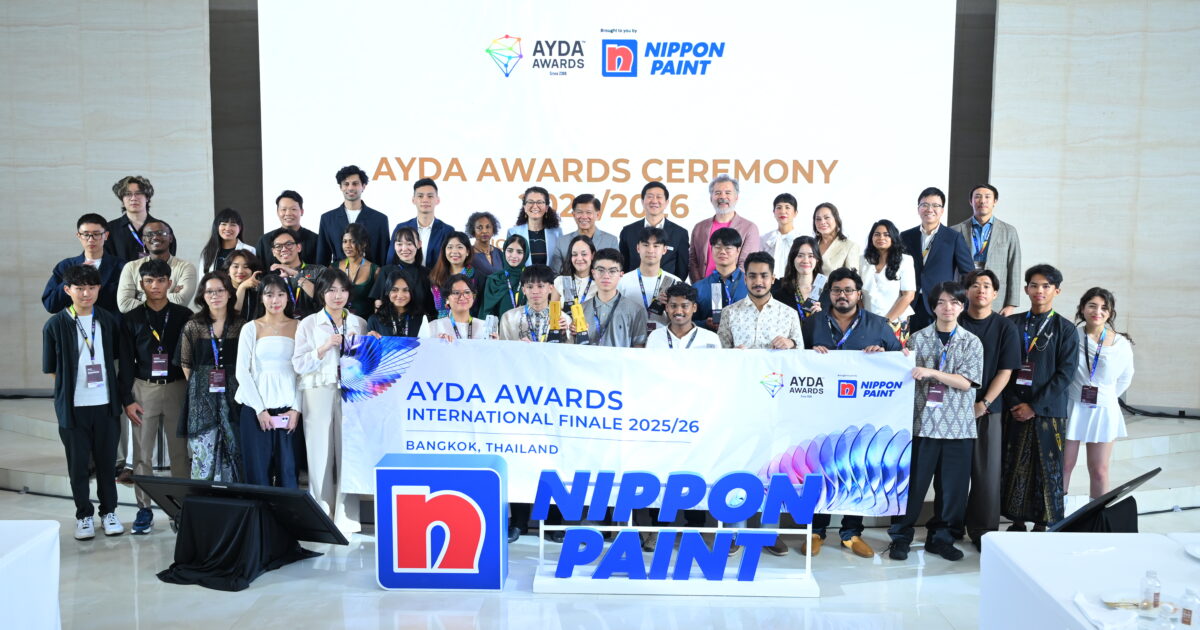
Long before either of them stepped onto an international stage, their greatest design influences looked surprisingly ordinary.
For Ehjey Durias, it was the quiet familiarity of the bahay kubo and the stilt houses that lined the coastal communities of Mindanao, where he grew up watching the lives of the Sama-Bajau unfold by the sea.
For Patricia Danielle Malijan, it was bahay-bahayan — building imaginary homes out of bedsheets, pillows and whatever she could find around the house. Those makeshift playhouses became the backdrop of countless afternoons spent with neighborhood friends.
Years later, those childhood memories would become something far bigger than nostalgia.
They became the foundations of two internationally recognized designs that gave the Philippines its biggest breakthrough yet at AYDA Awards (formerly known as the Asia Young Designer Awards).
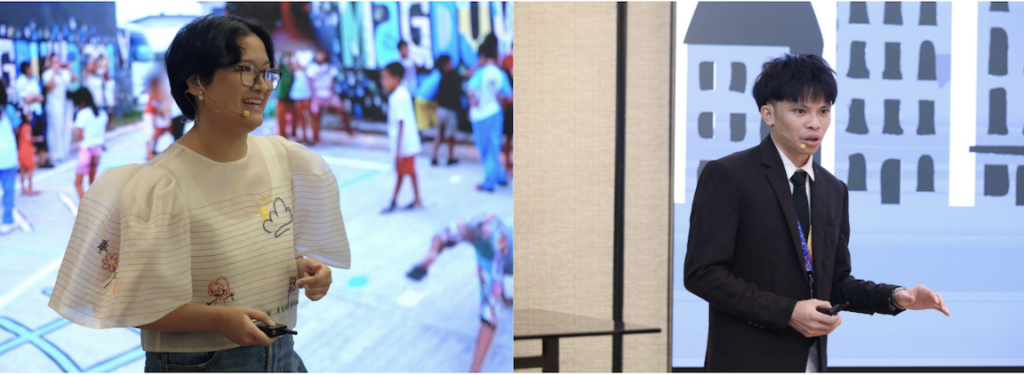
Patricia Danielle Malijan (left) and Ehjey Durias (right) presenting their projects to the judges
Durias became the first Filipino ever to win Designer of the Year (architecture), the competition’s highest honor, while Malijan received the prestigious Nippon Paint Colour Award (interior design), making her only the third Filipino to earn the distinction.
Their projects were very different — one reimagined a coastal settlement for the displaced Sama-Bajau, while the other revived traditional Filipino childhood games through interior design. Yet both shared the same starting point: familiar Filipino experiences transformed into meaningful spaces.
For Chen Lee Siong, General Manager of Nippon Paint (Coatings) Philippines, that is precisely what made the projects stand out.
“This is definitely a testament to the talent and the quality of our people in the Philippines,” he said. “Finally, after more than 18 years, we won the main prize — the Designer of the Year.”
The Philippines has participated in the AYDA Awards for about a decade, producing finalists and category winners but never claiming the competition’s top architectural honor. This year, two deeply rooted Filipino stories finally changed that.
A bahay kubo reimagined for the sea
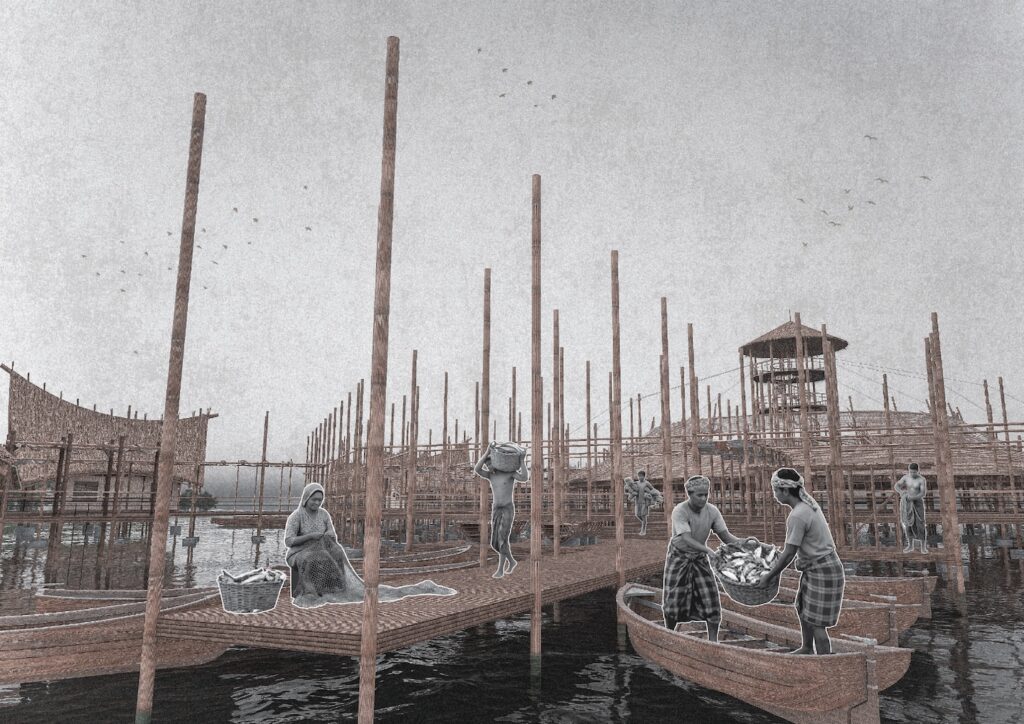
Design of a boat docking area in Durias’ “Banuas Lawod“
Durias’ winning project, Banuas Lawod, did not begin with architecture. It began with listening.
Growing up in Panabo City in Davao del Norte, he frequently visited nearby coastal communities with his family. While he admired the simplicity of life by the sea, he gradually noticed that many Sama-Bajau families were disappearing from places they had long called home.
To understand why, he spent months interviewing residents, not only those who remained but also those who had already been displaced and forced to move into cities.
“I talked to many Bajau communities, not only in the project site but also in other parts of Davao,” he said. “Some had already left their communities and were surviving in the city. I gathered all those stories before coming up with a solution.”
The result was Banuas Lawod, or “community of the sea” — a proposal that goes beyond housing by creating opportunities for fishing and aquaculture while preserving the Sama-Bajau’s culture and way of life.
Although Durias is not part of the indigenous community, he said that made listening even more important.
“I really admired their simple way of living,” he recalled. “I never fully understood the challenges they were facing. That realization inspired me to design with greater empathy and purpose.”
The architecture itself reflects that philosophy.
Rather than chase futuristic forms, Durias drew from one of the country’s most recognizable structures: the bahay kubo. By blending its familiar silhouette with the iconic stilt houses of the Sama-Bajau, he created a design that feels unmistakably Filipino while responding to the realities of coastal living.
“If given the chance, I hope the project becomes more than just a place to live,” he said. “I hope it strengthens their livelihood, preserves their culture and gives the community a greater sense of security and belonging.”
His victory also earned him a three-week study attachment at the Harvard Graduate School of Design through AYDA’s partnership with the university.
Rather than seeing Harvard as a new beginning, Durias hopes to continue developing Banuas Lawod before eventually bringing those lessons home.
“I want to come back here and give back to AYDA,” he said. “I also want to support future Filipino designers, teach them what I’ve learned, and create more impact locally.”
The design lesson hidden in bahay-bahayan
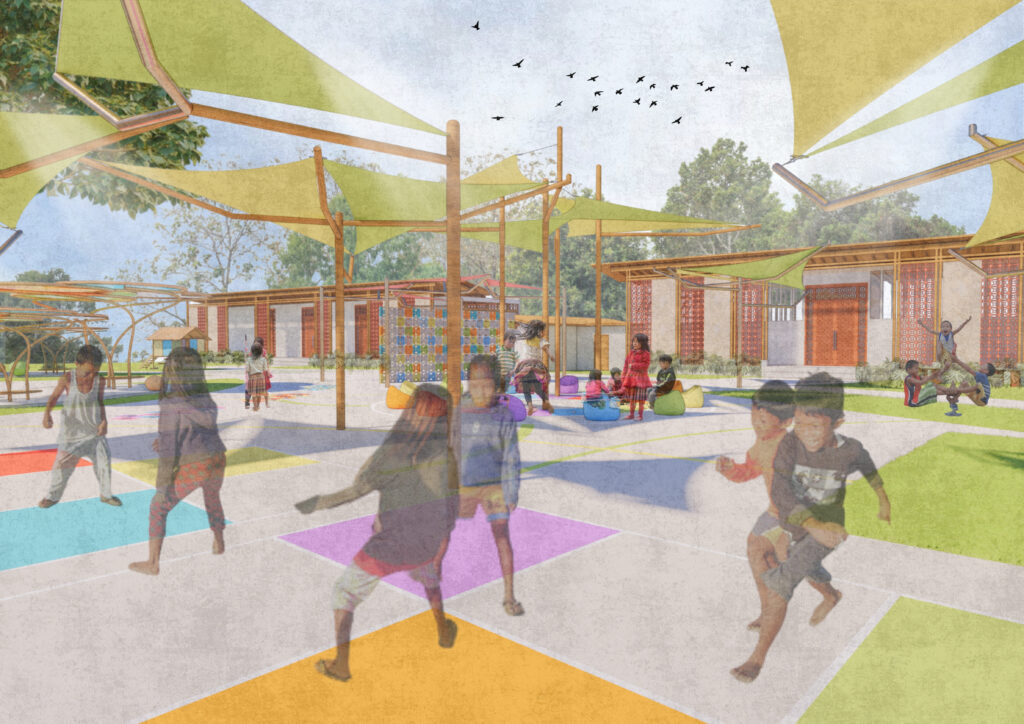
Malijan’s colorful depiction of a traditional playground in “KAMPIHAN“
Malijan’s inspiration came from a very different place.
During a university immersion program, she and her classmates worked with children in an underserved community. She expected to see playgrounds filled with laughter.
Instead, she found children glued to their phones.
“The most accessible playground was a phone,” she recalled. “The children were playing Roblox because the community playground wasn’t really a playground anymore. It had become a hazard.”
The experience made her wonder whether interior design could help preserve something more intangible than buildings: childhood itself.
Her project, KAMPIHAN, reimagines children’s spaces around traditional Filipino games such as patintero, piko, luksong-baka and luksong-tinik, encouraging children to rediscover forms of play that once brought neighborhoods together.
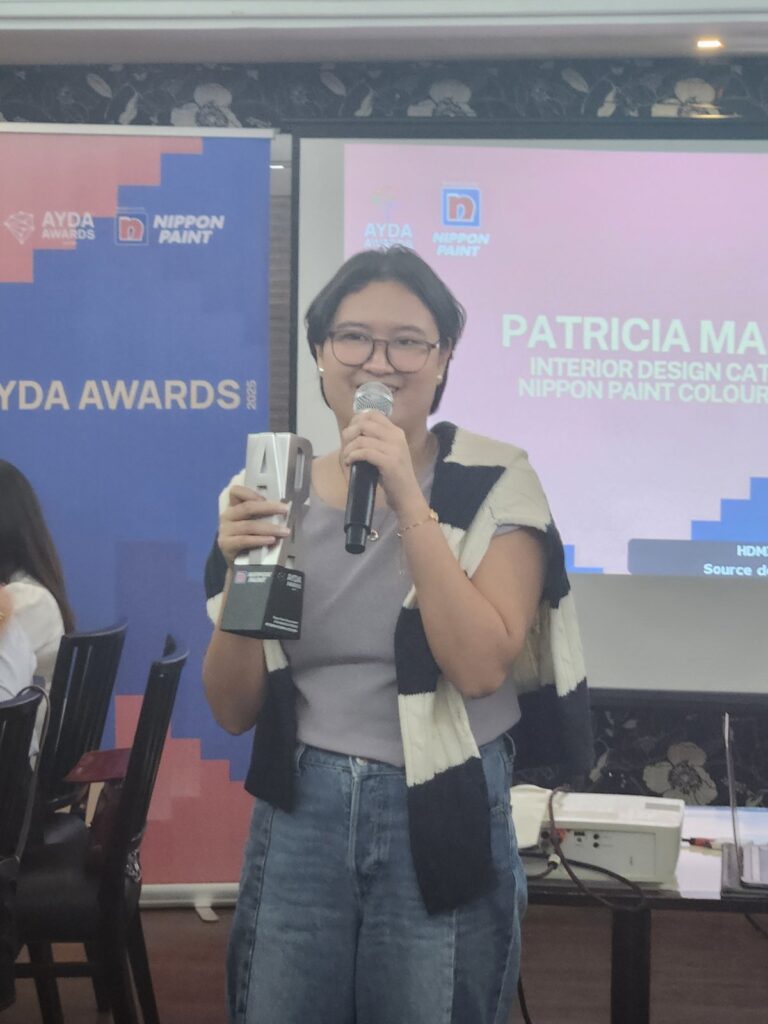
Patricia Danielle Malijan, holding her trophy, while delivering a thank you speech
But beneath those games lies another childhood memory that quietly shaped the entire concept.
“I remember playing bahay-bahayan,” she said with a laugh. “We didn’t even need a dollhouse. We used bedsheets, pillows and everyday things around the house.”
Only years later did she realize those improvised playhouses were teaching her the fundamentals of space, imagination and design.
“Those childhood memories definitely shaped the designer I’ve become,” she said. “A big portion of my project is actually dedicated to bahay-bahayan.”
Ironically, she never expected to win an award celebrating color.
“Among my friends, I wasn’t the best designer,” she admitted. “I was usually just the project manager. So, winning the Colour Award was super surprising. Looking back, it showed me how much I’ve grown as a designer.”
She hopes to use the US$1,000 prize as seed capital toward eventually opening her own design practice.
Human stories before technology

Ehjey Durias (left) with Chen Lee Siong, General Manager of Nippon Paint (Coatings) Philippines
Artificial intelligence has become part of many designers’ workflows, but Chen believes technology had little to do with why the Philippine entries succeeded.
“They are grounded,” he said. “They’re not designs for the sake of design. They must contribute back to society. They must be relevant and something that can actually happen in the real world.”
AI, he added, remains just another tool.
“You can’t escape AI. It helps people work faster and more efficiently. But the originality of the ideas must still come from them.”
Durias agrees.
While he used AI-assisted software to visualize parts of his presentation, he said the design itself came from months of field research, site visits and conversations with the communities his project hoped to serve.
More than winning
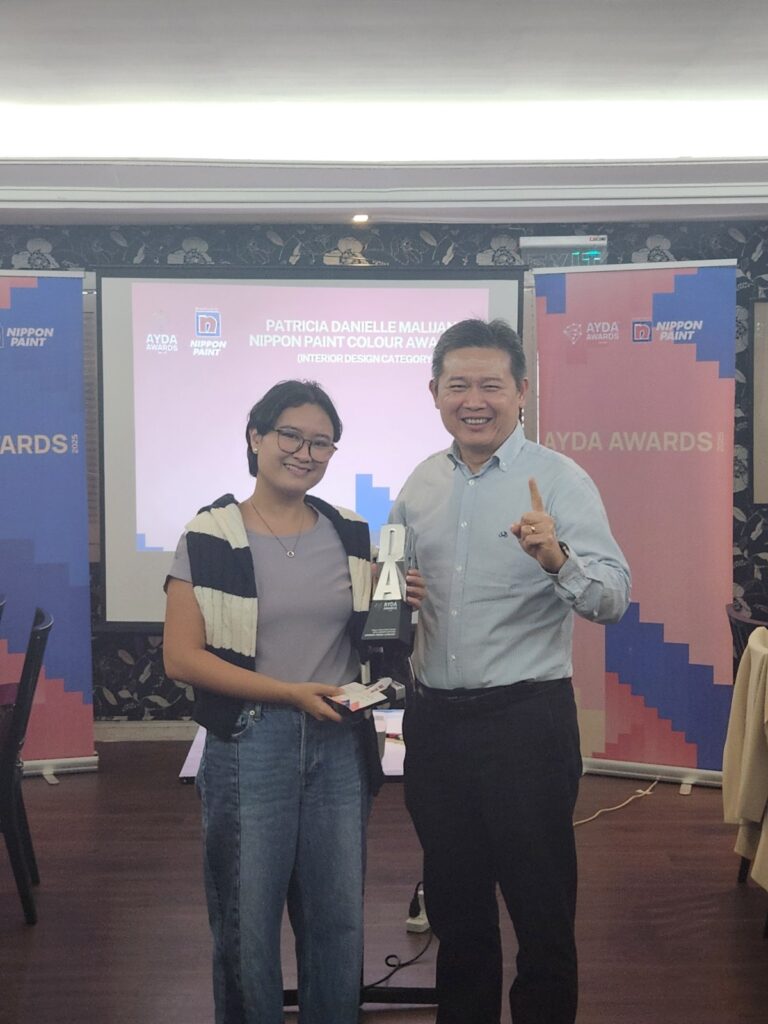
Patricia Danielle Malijan (left) with Chen Lee Siong of Nippon Paint (Coatings) Philippines
Chen believes this year’s breakthrough reflects years of mentoring by educators, architects, interior designers and industry partners who have steadily raised the standard of Philippine entries.
The country also recorded its highest participation yet in AYDA, with 2,284 submissions from universities across Luzon, Visayas and Mindanao.
He hopes this year’s winners will eventually follow the path of many previous AYDA alumni by returning as mentors themselves.
“We have winners who now own their own companies,” he said. “They’ve come full circle by giving back to AYDA as mentors and judges.”
In the end, neither of this year’s winning designs relied on flashy technology or futuristic aesthetics.
One looked to the humble bahay kubo and the stilt homes of the Sama-Bajau. The other returned to bahay-bahayan, neighborhood games and the simple joy of creating imaginary worlds from everyday objects.
The inspiration was unmistakably Filipino.
And on the international stage, that authenticity proved to be their greatest design advantage.