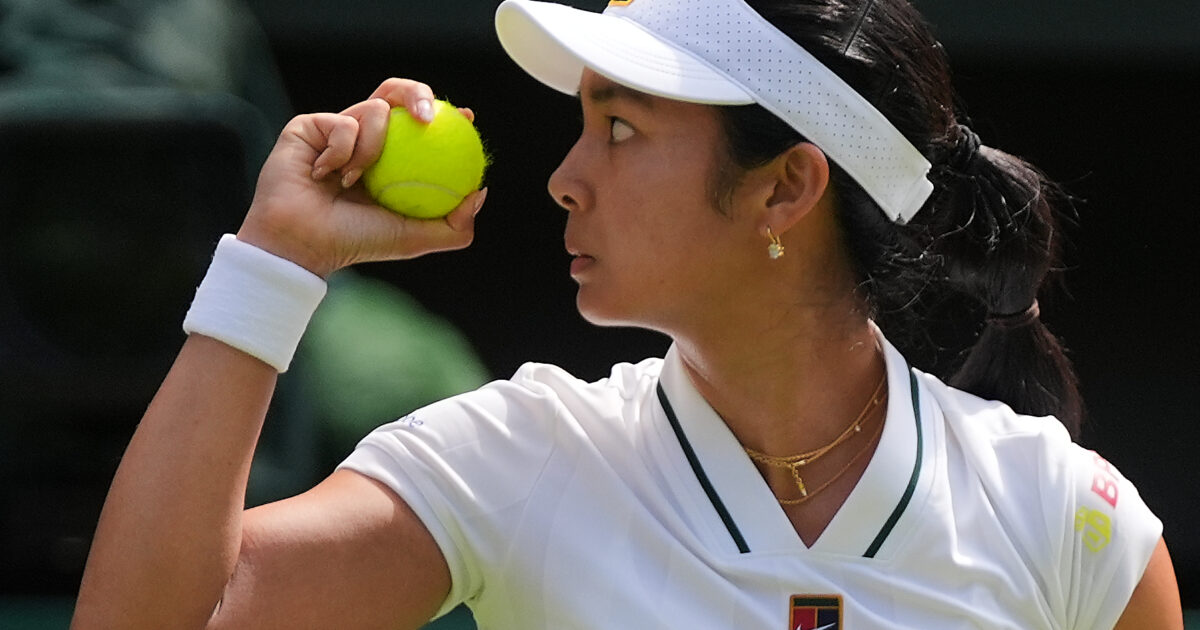
On a tennis court, silence is part of the game. Spectators are expected to stay quiet during rallies, saving their cheers for the end of each point.
That unwritten rule was tested several times at Wimbledon this year as Alexandra “Alex” Eala produced one breakthrough after another, giving Filipino tennis fans moments they had never experienced on one of the sport’s biggest stages.
Even before striking her first ball at the tournament, Eala had already made history as the first Filipina to be seeded at a Grand Slam, entering Wimbledon as the No. 29 seed.
She then delivered one of the tournament’s biggest upsets by defeating defending champion and World No. 3 Iga Swiatek in straight sets, 7-6 (11-9), 6-2, sending Centre Court into celebration and drawing worldwide attention to Philippine tennis.
Although her run ended in the fourth round against Jasmine Paolini after a hard-fought three-set match, many believe her biggest victory may have come off the court.
From Grand Slam headlines to grassroots interest

Almost overnight, tennis returned to the national conversation.
Social media buzzed after every match, clips of Eala’s victories spread rapidly online, and calls for free television broadcasts grew louder as more Filipinos followed her campaign.
For a sport that has long taken a back seat to basketball and volleyball, the response marked one of Philippine tennis’ biggest moments in recent memory.
Government agencies and sports organizations quickly responded by organizing public watch parties at the PhilSports Arena in Pasig City, allowing fans to experience Eala’s matches together despite the time difference.
The scenes reflected something Philippine tennis has not seen in years: widespread public excitement.
Officials from the Philippine Tennis Association (PHILTA) have since observed growing interest in the sport, particularly among young players and families inspired by Eala’s achievements. They noted that her success has encouraged more Filipinos to explore tennis as a viable sport rather than viewing it as a niche activity.
A new generation discovers tennis

Eala’s rise comes at a time when access to tennis is gradually improving.
Although the sport has traditionally been perceived as expensive and exclusive, more public courts, community programs, mall-based facilities, and school initiatives have emerged in recent years, making tennis more accessible than before. .
The Filipina tennis star’s breakthrough gives those efforts renewed momentum.
For young athletes, Eala has shown that competing with — and defeating — the world’s best is no longer beyond reach. For parents, she offers proof that tennis can provide opportunities on the international stage.
Her personal mantra, “Kapag lumago, hindi na hihinto,” has become symbolic of that momentum. Once interest begins to grow, it becomes increasingly difficult to stop.
Reviving a proud tennis tradition

Long before Eala captured international headlines, other Filipino players had already left their mark on world tennis.
Other Pinoy legends such as Felicisimo Ampon and Raymundo Deyro competed successfully on the international stage during the 1940s and 1950s, including appearances at Wimbledon. Over time, however, tennis gradually faded from mainstream attention as basketball and volleyball became the country’s dominant sports.
Eala’s Wimbledon campaign has helped bring that history back into the spotlight.
Her achievements are also beginning to influence industries beyond sports.
As more Filipinos pick up rackets and try the sport for themselves, demand for coaching programs, new community courts and training centers is also growing. Retailers are stocking more tennis gear, while schools, malls, and local communities are gradually expanding access to courts and training opportunities.
More than wins and rankings

At just 21 years old, Eala’s career is still in its early chapters.
Whether she wins a Grand Slam title in the coming years remains to be seen. But her impact is already evident.
Her Wimbledon run has done more than improve her ranking. It has reintroduced tennis to a new generation of Filipinos, inspired young athletes to dream bigger, and reminded the country that success on the global stage is possible — even in a sport long considered outside the mainstream.
That may ultimately become the true legacy of the “Eala Effect”: not simply producing victories, but helping plant the seeds for Philippine tennis to flourish once again.