Health advocates and medical specialists are urging stronger implementation of HPV vaccination and cervical cancer screening programs as the Philippines works toward eliminating one of the country’s most preventable cancers.
Every day, an estimated 12 Filipinas die from cervical cancer — a disease that health experts say is largely preventable through vaccination, regular screening, and early treatment.
Despite advances in medical science and the availability of effective prevention tools, cervical cancer remains the second most common cancer among women in the Philippines.
According to 2022 data from the Global Cancer Observatory (Globocan), the disease accounts for approximately 8,549 new cases and 4,380 deaths each year.
The challenge of closing this gap between medical capability and public access was the focus of discussions during the recent Together for Health: Towards a Cervical Cancer-free Philippines forum, held in observance of Cervical Cancer Awareness Month.
Gathering healthcare leaders, policymakers, patient advocates, and medical specialists, the forum highlighted both the progress made in cervical cancer prevention and the work that remains to ensure more women benefit from existing interventions.
A preventable cancer
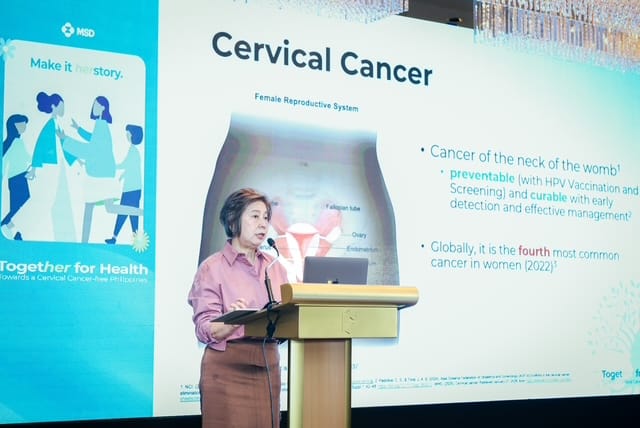
Dr. Christia Padolina, Program Director for Cervical Cancer Elimination of the AOFOG
Unlike many other cancers, cervical cancer has a well-established cause: persistent infection with high-risk strains of the human papillomavirus (HPV).
Because the disease pathway is clearly understood, experts say prevention strategies are also well-defined.
“We already have the tools to fight it,” said Dr. Christia Padolina, Program Director for Cervical Cancer Elimination at the Asia Oceania Federation of Obstetrics and Gynecology (AOFOG). “We have vaccines that can prevent HPV infection, screening tests that can detect disease early, and treatments that can stop progression to cancer.”
The World Health Organization (WHO) has outlined a global cervical cancer elimination strategy built around its “90-70-90” targets: vaccinating 90 percent of girls against HPV by age 15, screening 70 percent of women with high-performance tests, and ensuring 90 percent of women diagnosed with cervical disease receive appropriate treatment.
Many countries in the Asia-Pacific region have already intensified efforts to meet these goals through expanded vaccination programs and wider use of HPV DNA testing, which is considered a more sensitive screening method than traditional approaches.
Padolina noted that while the Philippines currently uses the quadrivalent HPV vaccine, regional discussions continue to explore broader-protection vaccines and newer screening technologies as part of long-term elimination efforts.
Vaccination remains the first line of defense

Dr. Ana Victoria Dy-Echo, Chair of the Philippine Obstetrical and Gynecological Society (POGS)
Committee on Women’s Cancers
Medical specialists continue to view HPV vaccination as the most effective strategy for preventing cervical cancer before it develops.
Dr. Ana Victoria Dy-Echo, chair of the Philippine Obstetrical and Gynecological Society’s (POGS) Committee on Women’s Cancers, pointed to international data showing significant declines in cervical cancer rates among countries with established vaccination programs.
“HPV vaccination remains the optimal strategy for primary prevention,” Dy-Echo said.
She added that cervical cancer occupies a unique position among cancers because it can be addressed at multiple stages — from preventing HPV infection through vaccination to detecting precancerous changes through screening and treating disease before it advances.
Screening remains a weak point
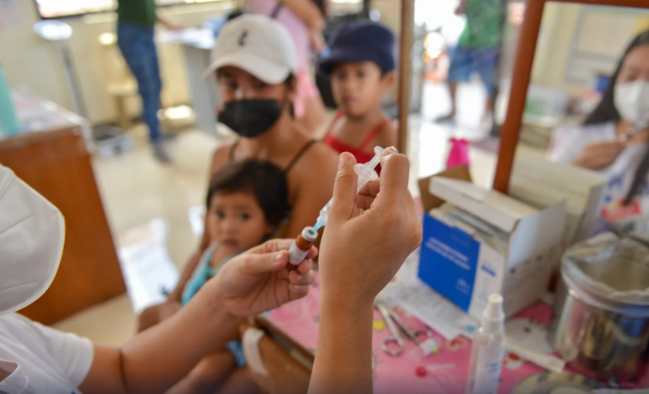
IMAGE CREDIT: Freepik
While vaccination efforts continue, experts say one of the country’s biggest challenges is increasing participation in cervical cancer screening.
According to figures cited during the forum, only about 1.27 to 1.29 percent of the female population underwent cervical cancer screening in the past year.
For health advocates, the low screening rate highlights a persistent disconnect between available medical services and actual access to care.
“We must move toward broader adoption of HPV DNA testing,” Padolina said, emphasizing that early detection allows healthcare providers to intervene before cancer develops or progresses.
Healthcare professionals also stressed that screening remains critical even for women who have been vaccinated, since no vaccine offers complete protection against all HPV strains associated with cervical cancer.
From policy to implementation

POGS President Dr. Concepcion Rayel leading the ceremonial “Sounding the Call for Elimination” gong strike during the event
Experts at the forum agreed that scientific advances alone will not be enough to eliminate cervical cancer.
Dr. Concepcion Rayel, president of POGS, said the country already possesses many of the resources needed to reduce the disease burden, including trained specialists, screening technologies, and treatment capabilities.
“What we need is leadership and a clear roadmap so that everyone moves in the same direction,” Rayel said.
Forum participants repeatedly pointed to implementation as the next major hurdle. Expanding vaccination coverage, improving screening access, maintaining vaccine supply chains, and strengthening public awareness campaigns all require sustained coordination among government agencies, local governments, schools, healthcare workers, and community organizations.
Teodoro Padilla, executive director of the Pharmaceutical and Healthcare Association of the Philippines (PHAP), emphasized the need for reliable vaccine supply and stronger partnerships to improve uptake, while Cancer Coalition of the Philippines vice president Carmen Auste highlighted the importance of reaching women in underserved and geographically isolated communities.
“Success should be measured by whether the woman with the least access, the least income and the least voice is reached, served and protected,” Auste said.
Turning commitment into action
The forum concluded with a symbolic call for stronger collaboration across sectors, underscoring a message repeatedly echoed throughout the discussions: cervical cancer elimination is achievable, but only if proven interventions reach more women.
For health advocates, the urgency is clear. Behind every statistic are mothers, daughters, sisters, wives, and friends whose lives could potentially be saved through timely vaccination, screening, and treatment.
The science, experts say, is already available. The challenge now lies in translating that knowledge into broader, more consistent access to care across the country.