
For a brief but unsettling moment on Tuesday night, the internet felt like it paused. As reported in Newsbytes.ph, timelines refused to load, pages hung mid-refresh, and even everyday tools people rely on for work and creativity simply wouldn’t budge.
Major services like X (formerly Twitter), OpenAI, and Canva were among the platforms that suddenly went dark, all caught in the ripple effects of a global Cloudflare outage that left millions of users staring at error messages instead of screens that usually spring to life.
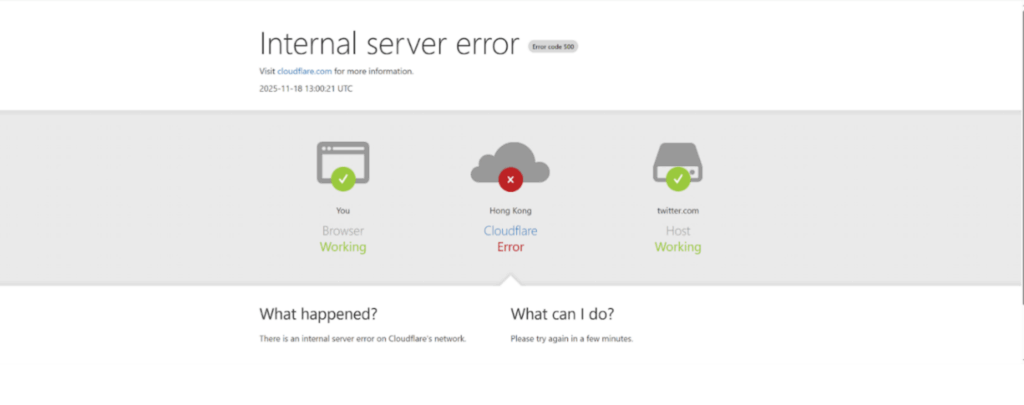
(Internal server prompt received by users when accessing sites like X / CREDIT: Arianna Aguiluz)
A slow, confusing start
The earliest signs of trouble began around 7:00 PM (Manila time), when users started voicing the same quiet confusion online — at least on the apps that still worked. X wouldn’t refresh. Canva refused to load projects. Some websites timed out entirely, while others produced cryptic server errors.
At first, many assumed their own WiFi was the culprit — another glitchy evening in the city. But as more people compared notes, it became clear the problem wasn’t local at all.
The issue was soon traced back to Cloudflare, a giant in global web infrastructure whose services quietly support over 20% of all websites today.
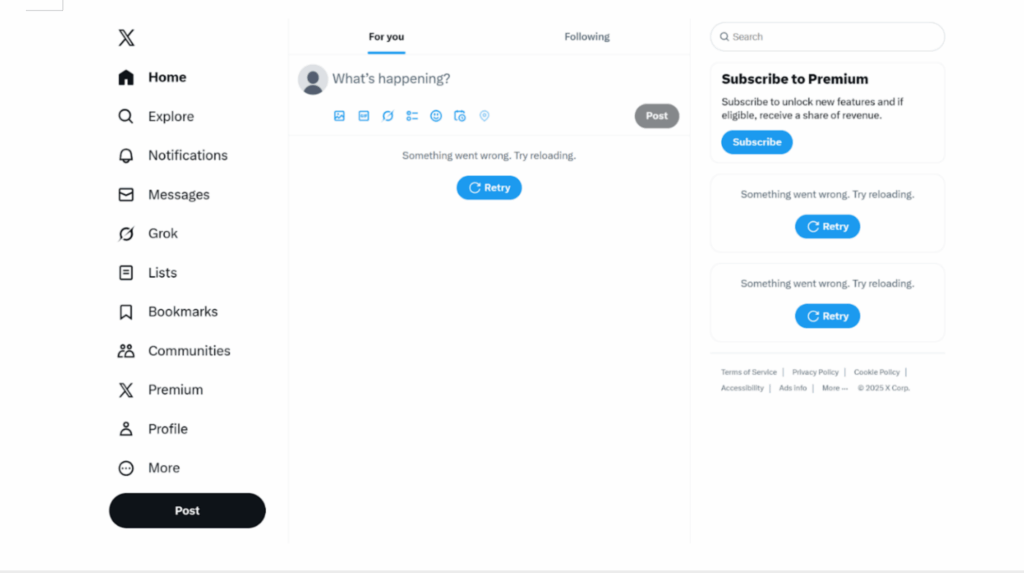
(X is unresponsive for many users amid global Cloudflare outage / CREDIT: Arianna Aguiluz)
By 7:38 PM, Cloudflare released its first public acknowledgment, calling the situation an “internal service degradation.”
The phrasing was technical, almost sterile, but the impact was very real: a significant portion of the internet had simply tripped over itself.
Cloudflare CTO apologizes: “We failed our customers“
Not long after, Cloudflare CTO Dane Knecht addressed the issue directly on X — which, somewhat ironically, many users still could not access. His post was candid, almost disarmingly so for an executive whose network quietly keeps a huge part of the world online.
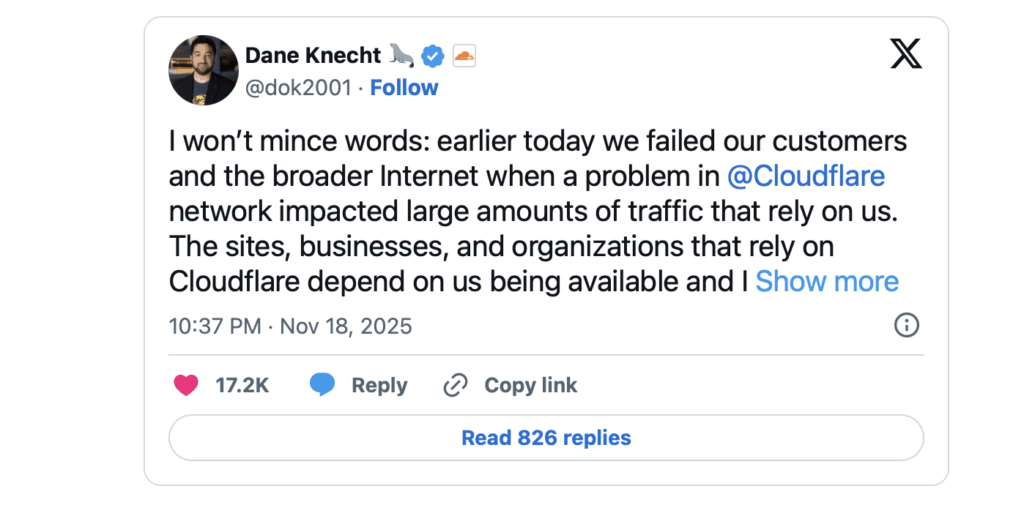
“I won’t mince words,” he wrote. “Earlier today, we failed our customers and the broader internet when a problem in @Cloudflare network impacted large amounts of traffic that rely on us.”
Knecht went on to give a more detailed explanation.
According to him, a latent bug in a service tied to Cloudflare’s bot mitigation system began crashing after a routine configuration change. That single break triggered a cascade — one that spread rapidly across Cloudflare’s network and services.
“This was not an attack,” he added, likely pre-empting speculation of cyberthreats.
As of late evening, Cloudflare’s status page listed Manila as partially re-routed, meaning traffic was being redirected to alternative pathways while engineers worked through the fix. The internet, patched together and limping, slowly started coming back online.
A symptom of something bigger
While the situation appears to be stabilizing, the outage raises broader questions about the way the digital world is built — and the fragility hidden beneath its sleek, everyday convenience.
First, the incident highlights our growing dependence on centralized services. Cloudflare is not a household name for most people, yet nearly everyone touched a part of its infrastructure without realizing it.
When one company underpins such a large slice of the internet, even a single misconfiguration can feel like a global event.
This isn’t new, either.
Just last month, Amazon Web Services (AWS) suffered a separate outage that similarly knocked multiple services offline. These moments are reminders: the internet is vast, but its foundations are held up by a surprisingly small number of players.
Second, the outage exposes how business continuity is now tied directly to digital reliability. Companies without backup plans don’t just lose access to tools — they lose customers, data, and valuable time. A glitch in California can stop a shop in Quezon City from completing an online order. A bug in a server farm can freeze an entire newsroom’s workflow.
Lastly, the event underscores a reality many of us rarely confront: the more of our lives migrate online — from communication and creativity to work and daily logistics — the more vulnerable we become to unseen technical failures. A single error, invisible to most, can ripple outward and create a quiet standstill.
The Cloudflare outage will pass, and services will return to normal. But the momentary pause it forced on the world is a reminder of just how much trust we place in unseen networks — and how quickly everything can grind to a halt when those networks falter.