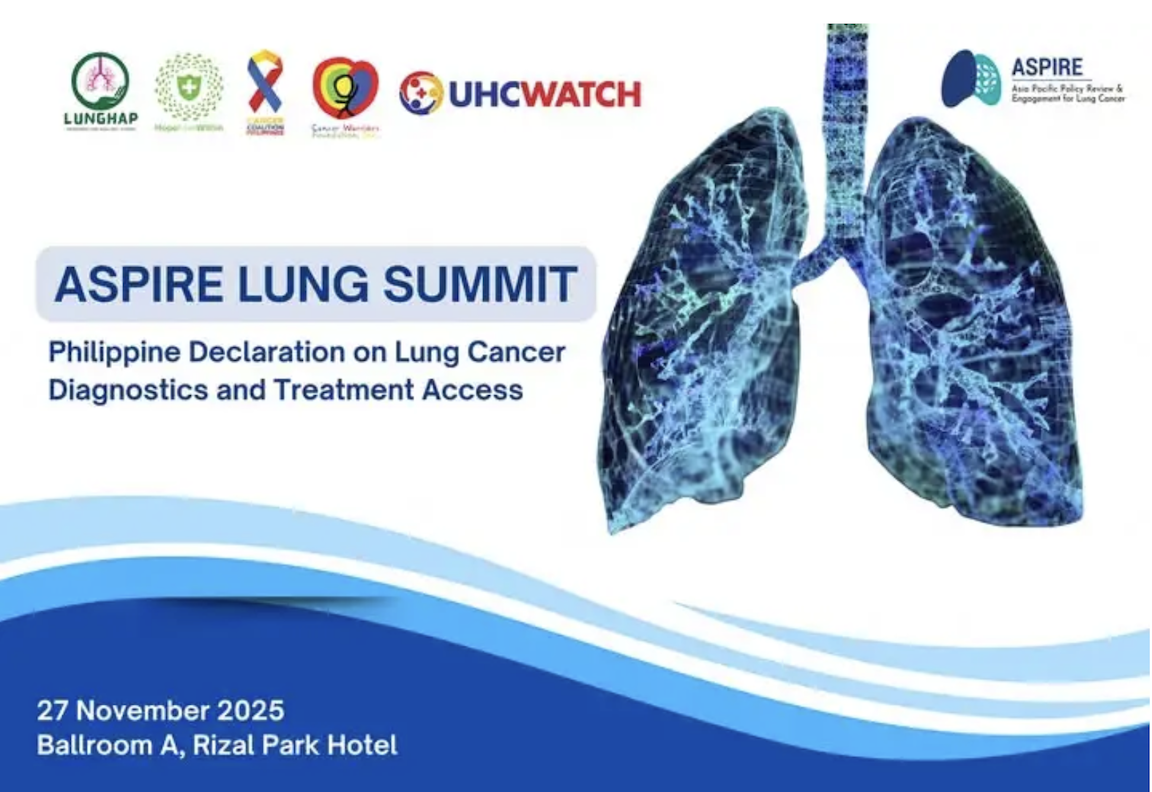
A strong call to expand PhilHealth coverage for lung cancer diagnostics and treatment dominated discussions at the “ASPIRE Lung Summit: Philippine Declaration on Lung Cancer Diagnostics and Treatment Access,” held this week by the Lung Health Alliance of the Philippines (LungHAP) with support from the Hope From Within advocacy.
The summit, attended by government leaders, medical societies, patient groups, and advocates, underscored the urgency of a comprehensive national benefit package that covers the full continuum of lung cancer care — from screening and diagnostics to biomarker testing and modern treatment.
Lung cancer remains the country’s deadliest malignancy, claiming more than 23,000 Filipino lives annually and accounting for the highest mortality rate among all cancers.
A key outcome of the event was the launch of the “Philippine Declaration on Lung Cancer,” a unified policy call aligned with the Asia-Pacific Lung Cancer Policy Consensus.
The declaration revolves around five pillars: prevention, early detection, access, partnerships, and stigma reduction. Stakeholders emphasized that localizing these principles is crucial to addressing gaps in affordability, diagnostic capacity, and treatment accessibility nationwide.
Speakers stressed that advanced technologies — such as biomarker-guided therapy, immunotherapy, and molecular profiling — have rapidly expanded treatment options. However, high costs and uneven diagnostic capacity continue to limit access.
“Early detection reduces treatment complexity, improves outcomes, and lowers household financial burden,” experts said during the forum.
Addressing costs, inequities, and stigma

The summit highlighted that many Filipinos are still diagnosed at late stages due to limited access to CT scans, molecular testing, and specialist evaluation. In rural areas, lung cancer symptoms are frequently mistaken for tuberculosis. Once the disease becomes metastatic, survival rates drop to around 5%, illustrating the life-and-death consequences of delayed diagnosis.
Improving the country’s diagnostic infrastructure emerged as a priority.
Low-dose CT scans cost around ₱10,000 — an amount many households cannot afford — while chest X-rays often miss small nodules. Speakers pointed to the promise of AI-assisted tools capable of detecting malignancies under one centimeter, calling them potential “game-changers” if integrated into public hospitals and covered by PhilHealth.
Reducing stigma also formed an important part of the discussion. While smoking remains a major risk factor, around 20% of Filipino lung cancer cases occur in people who have never smoked.
Advocates noted that misconceptions labeling lung cancer solely as a “smoker’s disease” discourage patients from seeking early help. Community education, survivor engagement, and stigma-reduction programs were framed as essential to improving care-seeking behavior.
Government leaders, including senators and Department of Health officials, expressed support through video messages, reinforcing the need for an expanded PhilHealth Z-benefit package. Some officials highlighted past efforts such as the Universal Health Care Law and the National Integrated Cancer Control Act, while acknowledging that lung cancer remains excluded from current Z-package coverage.
A unified commitment through the lung cancer declaration

Atty. Arnel Mateo delivers his welcome remarks at the “ASPIRE Lung Summit: Philippine Declaration on Lung Cancer Diagnostics and Treatment Access” event.
The declaration calls on Congress and the Department of Health to lead a whole-of-government response that includes stronger tobacco and vaping control, expanded screening guidelines, subsidized diagnostics, and equitable access to modern treatments such as surgery, radiotherapy, targeted therapy, and immunotherapy. It also urges investment in precision medicine tools, improved referral pathways, and stronger regional and international cooperation.
At the summit’s close, advocates reiterated that lung cancer is both a health and policy challenge that affects families, productivity, and national health systems. “Our goal is simple yet profound: to save lives by dramatically reducing lung cancer deaths in the Philippines,” said Atty. Arnel Mateo, Chairman of the Lung Health Alliance of the Philippines, Inc. (LungHAP).
Stakeholders encouraged the public to support ongoing efforts for policy reform and comprehensive PhilHealth coverage by participating in awareness campaigns and signing national petitions for expanded benefits.
As the push for stronger national support continues, the ASPIRE Lung Summit marks a significant step toward making timely diagnosis and modern treatment accessible for every Filipino at risk of — or living with — lung cancer.