On October 20, 2025, a disruption in Amazon Web Services (AWS)’s Northern Virginia region briefly knocked parts of the global internet offline.
Beyond the technical headlines, the event highlights how much daily life — from food delivery to finance — depends on a few unseen digital threads, and what businesses can do to keep their systems resilient when those threads snap.
The morning the internet slowed down

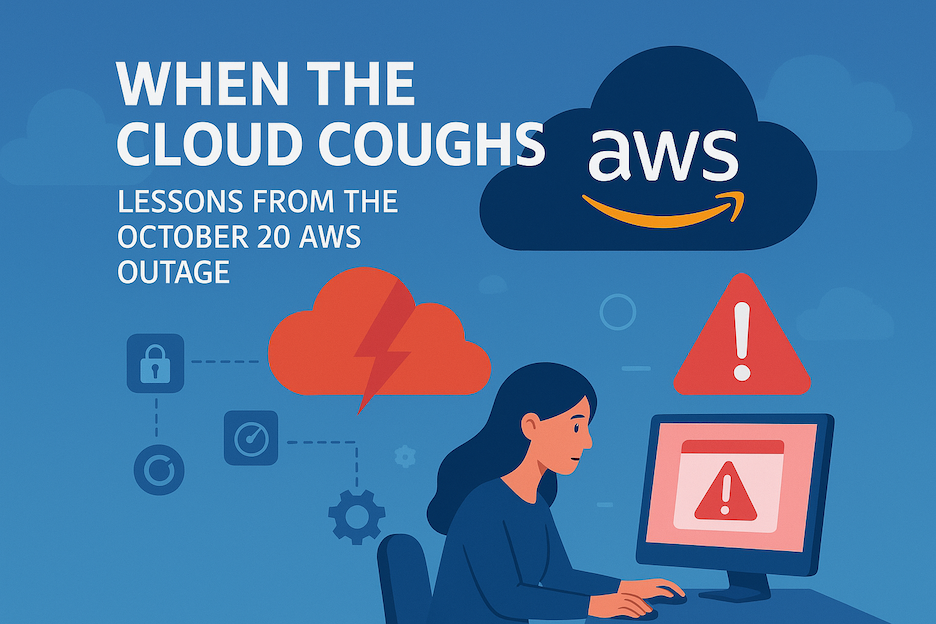
When software engineer Annabelle Cruz logged in for work on October 20, she didn’t expect to see a wall of red alerts on her dashboard.
“I thought it was a glitch,” she said. “But within minutes, our customer tickets were piling up — login errors, timeouts, failed payments. That’s when I knew it wasn’t us. Something bigger was happening.”
It was.
Shortly after 3 a.m. Eastern Time, Amazon Web Services (AWS) reported “increased error rates and latencies” across multiple services in its US-EAST-1 (Northern Virginia) data center — one of the busiest cloud regions in the world. Over the next few hours, the disruption rippled across the digital landscape: from social apps and e-commerce sites to online food delivery, ride-hailing platforms, and even government service portals.
AWS engineers later traced the issue to a Domain Name System (DNS) resolution failure tied to the DynamoDB API endpoint. A short-lived glitch — but one that caused a long chain reaction.
By mid-morning, millions of users had already felt it.
The domino effect of a digital disruption

DNS, often called the “phone book of the internet,” translates domain names into the numerical addresses that computers use to connect. When those translations fail, even healthy systems become unreachable.
“The DNS failure was like cutting a key phone line in a city,” Annabelle explained. “Traffic backed up everywhere. Apps that depend on DynamoDB for user sessions or payments simply froze.”
Among those affected were major consumer platforms such as Venmo, Snapchat, Fortnite, and Duolingo, as well as Amazon’s own services like Alexa, Ring, and Prime Video, according to reports from Reuters and Tom’s Guide.
In the Philippines, payment apps and e-commerce platforms relying on AWS-hosted authentication systems saw intermittent downtime. Some restaurants using online ordering platforms were unable to process transactions. For delivery riders and small merchants — the “plates” part of the modern digital economy — that meant lost income for the morning rush.
In some government offices, cloud-linked scheduling systems slowed, delaying appointments and digital public services. It wasn’t catastrophic — but it was revealing. “It’s sobering,” Annabelle reflected. “One cloud provider hiccups, and half the internet coughs.”
AWS’s quick response — and why it mattered

To its credit, AWS acted swiftly.
Mitigations were deployed within an hour, and by 6:35 a.m. ET, the company declared the issue fully resolved. Still, recovery took time due to what engineers call “caching tails” — outdated DNS records lingering in devices and resolvers across the globe.
“Even after AWS fixed the problem,” Annabelle said, “millions of users were still running bad DNS entries. You can’t just flip a switch.”
AWS later published a post-incident summary outlining the technical cause and confirming that no customer data was compromised.
Industry analysts noted that the outage underscored not a flaw unique to AWS, but a shared vulnerability of modern internet architecture — its deep interconnection and reliance on a few hyperscale cloud providers.
As one systems engineer put it: “It wasn’t a failure of AWS; it was a reminder of how much of the world runs on AWS.”
The real-world impact

While the outage was technical, its ripple effects reached far beyond servers and APIs.
Remote workers were unable to log in to company dashboards. Students lost access to e-learning portals. For many, it was a pause that revealed how intertwined daily routines are with the cloud.
Cities like Singapore, Manila, and Sydney — all routing significant traffic through the Northern Virginia region — experienced slowed services. Smart building systems, traffic data platforms, and even logistics tracking dashboards stalled temporarily.
The outage hit just before lunchtime in parts of Asia, delaying online food orders and ride-hailing transactions. Restaurants depending on cloud-based POS systems couldn’t process payments for over an hour.
“These are small disruptions individually,” said digital infrastructure analyst Mark Dela Peña. “But together, they show how a single technical point of failure can echo across livelihoods.”
Understanding the structural risk

The October 20 incident was not the first to originate in US-EAST-1, a region so central to AWS operations that it’s become a focal point for global internet traffic. Experts call this concentration risk — the tendency for critical systems to cluster in a handful of digital hubs.
“Companies think they’re redundant because they use multiple zones within a region,” Annabelle said. “But if the control plane or DNS layer of that region goes down, your redundancy doesn’t mean much.”
This “false sense of safety,” as she puts it, can blind organizations to their own dependencies.
Yet, as AWS’s prompt communication and technical response showed, the real challenge is less about a single provider’s reliability and more about how businesses build resilience around them.
Building digital resilience — lessons from the outage
Annabelle’s team has since implemented several safeguards:
- Multi-region redundancy for key systems like logins and payments.
- Shorter DNS cache times to reduce stale records.
- Offline contingency plans, including manual order-taking when cloud systems fail.
- Clear communication playbooks for notifying users during service disruptions.
“You don’t need a massive budget,” she said. “You just need awareness — and practice.”
AWS itself has emphasized the importance of shared responsibility in cloud resilience. While the provider ensures infrastructure stability, customers are encouraged to design architectures that anticipate and recover from rare but inevitable disruptions.
Beyond technology — a matter of trust

For many businesses, the real test of an outage is not technical recovery but maintaining customer trust.
“People forgive downtime,” Annabelle reflected, “but they don’t forgive silence.”
Her company now prioritizes quick, transparent updates — even if it’s just acknowledging an issue tied to a cloud provider. It’s a lesson in humility and human connection amid digital complexity.
A wake-up call for the digital economy
The October 20 AWS outage may have lasted only a few hours, but its lessons will linger far longer. It exposed not a single company’s weakness, but a collective dependency that spans continents and industries.
For consumers, it was an inconvenience. For engineers, a learning moment. For small businesses — especially those relying on cloud-based payment, delivery, or inventory systems — it was a reminder that resilience isn’t optional.
“The cloud didn’t fail,” Annabelle said. “It just reminded us that even the strongest systems can cough. Our job is to make sure the world keeps breathing when it does.”
In the end, the October 20 event wasn’t about blame — it was about awareness. Because as the global economy grows ever more digital, understanding where our dependencies lie may be the most practical form of preparedness there is.