
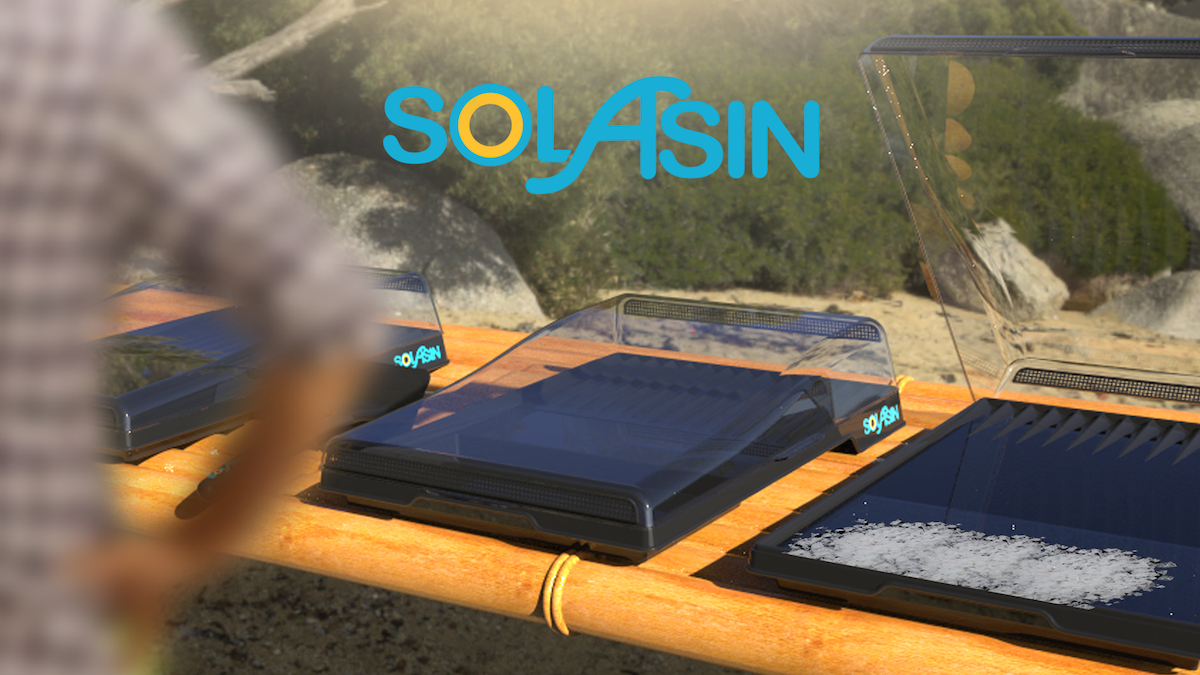
When University of the Philippines (UP) student John Carlo Luna Reyes invented SolAsin, a solar-powered salt-farming unit designed to empower coastal communities, he wasn’t just reviving an age-old livelihood — he was redefining how design can solve real-world problems. His innovation recently won the Philippine national prize at the 2025 James Dyson Award, a global competition that celebrates engineering ingenuity and gives young inventors the platform to scale their ideas worldwide.
Now in its 20th year, the James Dyson Award has become one of the most prestigious competitions for design engineers. Run by the James Dyson Foundation, an international education charity founded in 2002, the award has supported more than 400 problem-solving inventions and granted over ₱70 million in prize money to young innovators.
Winners receive not only funding but also global media exposure, often serving as a launchpad to turn prototypes into scalable solutions.
What makes the competition stand out is its simplicity: the brief challenges student participants to design something that solves a problem — whether it’s a daily frustration or a pressing global issue. Entrants retain full ownership of their intellectual property while going through a rigorous, multi-stage judging process. Each market first selects a national winner and two runners-up, after which Dyson engineers shortlist 20 projects globally. From this pool, Sir James Dyson himself selects the international winners, who each receive ₱2,168,000.
National winners like Reyes are awarded ₱361,300 to further develop their projects. Over the years, the competition has spotlighted groundbreaking inventions such as Athena, a portable device that helps chemotherapy patients prevent hair loss and Polyformer, a machine that recycles plastic bottles into affordable 3D printing filament. The James Dyson Foundation also extends its mission beyond the competition, investing in medical research and donating more than ₱11 billion to charitable causes worldwide.
A modern answer to an old industry’s decline

John Carlo Luna Reyes from UP Diliman has been named as the Philippine national winner of the 20th James Dyson Award for his invention, “SolAsin”
The Philippine salt industry was once a thriving livelihood source for coastal families.
But decades of policy gaps, technological stagnation, and environmental pressures left many farmers without support. Even with the passage of the Salt Industry Development Law, challenges remain.
“Growing up in Pangasinan, I saw firsthand how coastal communities struggled to access sustainable livelihood opportunities,” Reyes said. “As a designer and an Iskolar ng Bayan, I have always felt a responsibility to use my skills to empower my own community.”
SolAsin takes a direct approach to this problem. Instead of vast salt beds requiring hectares of land and heavy investment, the unit is portable, affordable, and sustainable. It uses only filtered seawater, sunlight, and occasional mixing to produce premium flaky salt — a high-value product that can be sold in smaller batches to restaurants, hotels, and even tourists.
How SolAsin works
The device is designed for simplicity and scalability. Reyes worked closely with coastal residents, local government units, and environmental officers to refine its usability. Over months of prototyping and testing, he incorporated community feedback to ensure that SolAsin is not only practical but also income-generating.
Unlike ordinary table salt, flaky salt has a softer texture and distinct flavor, prized by chefs and food enthusiasts worldwide. This makes it more profitable in smaller volumes, offering coastal communities a sustainable business opportunity without competing with industrial-scale salt imports.
SolAsin units could be deployed in clusters, enabling households to diversify income streams while reconnecting with their heritage as salt makers.
Recognition and support

Reyes’ invention recently won the Philippine national prize at the James Dyson Award 2025, earning him ₱361,300. He plans to use the funding to refine SolAsin’s design, improve materials, and prepare it for broader deployment. But for Reyes, the recognition is only part of the journey.
“This recognition is more than just a personal achievement — it is a win for the communities that inspired SolAsin,” he said. “My goal has always been to design with and for the people, and this award gives me the opportunity to further develop the project so it can truly uplift local salt farmers.”
Judges praised SolAsin for its simplicity, scalability, and social impact, noting how it integrated community input with thoughtful design.
A spark for young innovators

For Reyes, SolAsin is more than a design — it is a statement about what Filipino innovators can achieve when they look inward, to local communities and industries, for inspiration.
“I hope this inspires more young Filipino designers to look to our own communities and industries for solutions that can create lasting change,” he said. “After all, the best solutions often come from understanding our own backyard.”
As the Philippines works to reduce dependence on imported salt and provide sustainable livelihood opportunities for its coastal populations, innovations like SolAsin may mark the beginning of a new era.
By marrying traditional industries with modern design thinking, Reyes has shown that the future of innovation doesn’t always lie in high-tech labs — it can also be found on the sunlit shores of Pangasinan, where salt once defined a way of life.
Looking ahead
Reyes’ journey with SolAsin is only beginning.
With continued development, government support, and local adoption, the compact salt-farming unit could help reshape the Philippine salt industry — bringing back not only economic opportunities but also pride in a craft deeply rooted in the nation’s coastal heritage.
For now, SolAsin stands as a symbol of how Filipino ingenuity, guided by community and sustainability, can revive a fading industry and create new pathways for inclusive growth.