
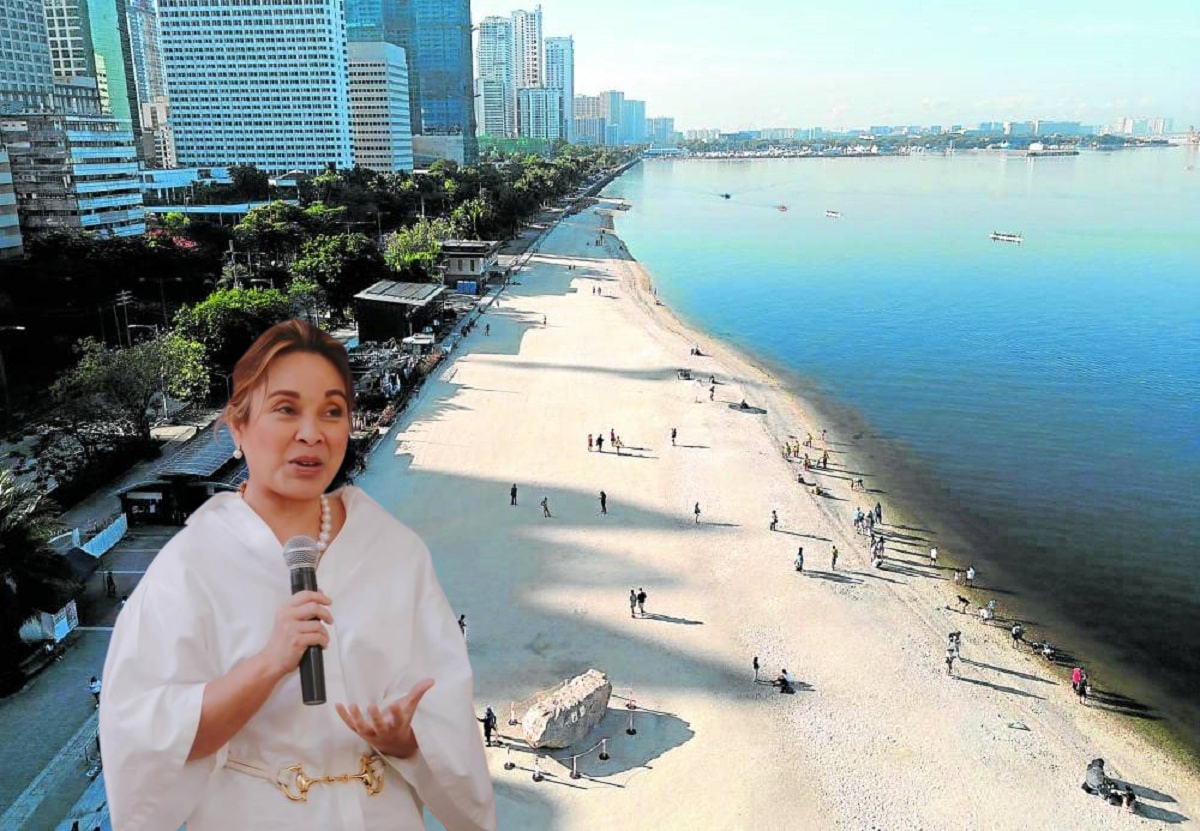
The Manila Bay Dolomite Beach — once hailed as a symbol of urban renewal — has again become the center of public debate following fresh criticisms from Senator Loren Legarda.
As flooding, sea-level rise, and waste pollution continue to threaten Metro Manila, questions are mounting over whether funds poured into the artificial beach could have been better used for long-term, science-based environmental solutions.
This issue touches on public spending, environmental sustainability, and Manila’s tourism strategy. As scrutiny deepens, some critics are asking: Could the Dolomite project become another controversy similar to alleged “ghost flood control projects” in the Philippines?
Dolomite Beach: A quick background
The Dolomite Beach is part of the Manila Bay Rehabilitation Program under the Department of Environment and Natural Resources (DENR). Launched in 2020, the project aimed to “beautify the Manila Bay shoreline,” improve public spaces, and boost Manila’s tourism appeal.
The beach used crushed dolomite rocks transported from Cebu, forming an artificial white-sand shoreline along Roxas Boulevard. At the height of its launch, thousands of visitors flocked to the area, with government agencies touting it as a new urban tourism destination that symbolizes “a cleaner, safer Manila Bay.”
But four years later, questions still linger—especially about its long-term environmental impact and financial relevance.
Sen. Loren Legarda: “I’ve never seen its purpose”
Senator Loren Legarda, a known environmental advocate, questioned the usefulness of the project, saying she has yet to understand its ecological or scientific value.

Photo Courtesy of Rappler
“Since the time it was built, I haven’t seen any importance in that project. Why do we want a white sand beach there? It’s artificial and should not have been transported from the Visayas to Manila Bay,” Legarda said.
Legarda stressed that while she supports urban beautification, such projects should be rooted in science, sustainability, and climate resilience—something she argues the Dolomite Beach fails to achieve.
“I’m fine with beautification — but only if it follows science. That project shouldn’t have been done,” she added.
Her statements have reignited public conversation about whether the DENR’s budget allocation for the Dolomite Beach was justified, especially when Manila continues to face chronic flooding, drainage issues, and pollution.
How much was spent on the Dolomite Beach?
The government spent over PHP 389 million for the beach nourishment, dolomite overlay, and associated works under the Manila Bay Rehabilitation Program. Some budget analyses estimate that broader rehabilitation activities — including shoreline stabilization and related infrastructure—reach into the billions of pesos.
For many critics, this raises a crucial question: Was “beautification” the best use of public funds in a flood-prone region like Metro Manila?
With recurring flooding in Manila, Pasay, Paranaque, and nearby coastal areas, many argue that these funds could have been strengthened:
- Modern flood control systems
- Drainage and pumping station upgrades
- Estero and river desiltation
- Sewage treatment facilities
- Mangrove restoration across the Manila Bay region
Environmental advocates maintain that dolomite overlays offer no long-term solution to water quality, coastal erosion, or urban flooding.
Environmental groups: “Dolomite sand is not a fix”
Several environmental organizations have long criticized the project, calling it a purely “cosmetic solution.”
Their primary points include:
1. Dolomite does not improve water quality
It does not reduce coliform levels, nor does it directly contribute to marine ecosystem recovery.
2. Artificial sand erodes easily
Crushed dolomite is highly susceptible to erosion, especially during typhoons and storm surges—meaning more public spending may be needed to maintain the beach.
3. Ecological impact at the source
Extracting and crushing dolomite rock in Cebu reportedly affects natural habitats and nearby communities.
4. Climate vulnerability
The project does not add meaningful protection against long-term threats such as rising sea levels, tidal flooding, and storm surge activity.
Critics argue that mangrove reforestation, wetland recovery, and wastewater treatment upgrades would have been far more effective, science-backed investments.
What do Manila residents think about the Dolomite Beach?
To understand public sentiment beyond official statements, we surveyed residents living in Pasay, Malate, and nearby coastal communities, as well as regular visitors to the Manila Baywalk area. Their perspectives reveal a divided community.

Photo courtesy of CNN
Positive feedback: “At least mas malinis na ngayon.”
Some residents appreciate the improvements in cleanliness and accessibility.
A Pasay resident shared, “Mas malinis talaga kaysa dati. At least may improvement kahit papaano. Libre pa, kaya maraming pamilyang pumupunta.”
Others said the beach area gave them a safer outdoor space for exercise and leisure, especially during the pandemic. Street vendors reported that increased foot traffic helped their small businesses.
Critical voices: “White sand won’t stop flooding.”
Many residents, however, questioned the project’s long-term value.
A Malate resident explained, “Maganda sa picture, pero binabaha pa rin kami. Sana inuna nila ‘yung flood control kaysa white sand.”
Some visitors also observed that portions of the dolomite sand seemed to thin out after strong waves, “Kapag malakas ang alon, parang nababawasan yung buhangin. Hindi tatagal [‘yung sand] kapag laging may bagyo.”
These mixed reactions highlight a key reality: while the Dolomite Beach succeeded in beautifying the shoreline, its practical usefulness remains contested, especially among those living closest to Manila Bay.
Supporters: “It helped tourism, boosted public morale.”
Amid the criticisms, several supporters maintain that the Dolomite Beach contributed positively to Manila tourism and helped uplift public morale.

Photo courtesy of MINES AND GEOSCIENCES BUREAU
Government officials often highlight:
- increased foot traffic along Roxas Boulevard,
- better visibility for Manila Bay online,
- renewed local interest in Manila as a tourist destination.
But analysts note that initial tourism boosts do not replace long-term environmental policy. Sustainable coastal tourism requires improved water quality, resilient infrastructure, effective waste management, and continued rehabilitation — not just an artificial shoreline.
Was the Dolomite Beach money better spent on flood control?
This is the heart of the controversy.
At a time when Metro Manila faces more frequent severe flooding, storm surges, and climate-related disasters, many believe the dolomite funds could have been diverted to more urgent priorities, including:
- anti-flood infrastructure,
- shoring up old drainage systems,
- river widening and dredging,
- eco-based coastal defenses, and
- shoreline ecosystem recovery
With renewed Senate attention, some Filipinos wonder if the Dolomite Beach could become another issue resembling the alleged ghost flood control projects of the DPWH—this time, with the DENR under scrutiny.
The bigger question: Was Dolomite Beach worth it?
The Dolomite Beach undeniably transformed the look of Manila Bay’s shoreline, providing an accessible space for recreation and tourism.
But as environmental problems persist, many are asking deeper questions:
- Was the project grounded in science and climate resilience?
- Does it address the root causes of Manila Bay pollution and flooding?
- Was the cost justified?
- Could the money have created more sustainable, long-term solutions?
With Senator Legarda’s criticisms, environmental groups’ objections, and residents’ mixed sentiments, the debate surrounding Manila Bay’s Dolomite Beach is far from over.
Whether it becomes another celebrated urban feature — or a costly misstep — depends on how the government and the public reassess priorities for Manila’s environmental future.