
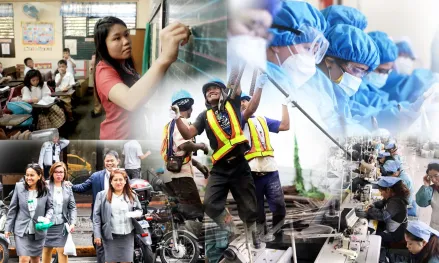
Discussions about the four-day workweek in the Philippines have shifted from theoretical policy debates to tangible workplace experiments.
In recent months, the Philippine government has explored implementing temporary compressed work schedule within selected agencies, sparking a renewed conversation on how Filipinos balance productivity with the heavy toll of modern urban life.
The mechanics of the shift
The model typically operates as a compressed schedule: employees fulfill the standard 40-hour weekly requirement within four days instead of five. In practice, this translates to 10-hour workdays anchored by the promise of a three-day weekend.
While the arrangement does not reduce total labor hours, it redistributes them to fundamentally alter commuting patterns, office operations, and daily domestic routines.

For a country where grueling commutes and rising transportation costs are a baseline reality, the proposal carries implications far beyond a simple calendar change.
It forces a confrontation with a long-standing question: Is productivity truly tied to hours spent at a desk, or to the efficiency of the output?
Government experiments and policy direction
The conversation gained momentum as the national government framed the compressed workweek as a strategic tool for operational efficiency. By shifting certain public offices to this model, officials hope to mitigate the twin pressures of traffic congestion and energy consumption.
Under this four-day workweek framework, participating agencies can adopt the schedule without violating civil service rules.
However, the rollout remains selective.
Essential services — those requiring daily, face-to-face public interaction — face significant hurdles in adoption. Consequently, the government views the four-day week as a flexible tool for modernization rather than a sweeping nationwide mandate.
The human toll and the three-day prize

For the average Filipino worker, the four-day workweek concept is met with a mixture of optimism and caution. The allure of an extra rest day is powerful in a culture where “work-life balance” often feels like a luxury.
In the dense urban arteries of Metro Manila, where employees frequently lose three to four hours a day to transit, eliminating just one day of commuting can result in significant financial savings and a lower “stress tax.”
However, the “compressed” nature of the week is a double-edged sword.
Ten-hour shifts demand a level of sustained mental and physical stamina that may be unsustainable in high-pressure or labor-intensive roles. Critics warn that chronic fatigue from extended days could eventually nullify the restorative benefits of the long weekend.
Rethinking the culture of “presenteeism”
At its core, the debate touches on the “culture of presence” — the traditional belief that productivity is measured by being physically visible at a desk. Global shifts toward flexible work suggest that results matter more than the clock, yet local implementation requires a massive shift in management philosophy.
For industries that never sleep — such as healthcare, retail, and BPOs — the four-day workweek model is a logistical puzzle. Success in these sectors would require sophisticated staggered shifts and increased staffing to ensure that service remains seamless while the “office” takes a break.
The future of the Filipino office

The four-day workweek proposal is more than a scheduling tweak; it is a reflection of a changing national identity. As economic pressures and technological shifts reshape our expectations, the rigid structures of the past century are being scrutinized.
For some, the three-day weekend is a path toward reclaiming personal agency. For others, the ten-hour day is a daunting hurdle. The success of this evolution will depend on honest evaluation and organizational empathy.
These benefits are particularly appealing to employees who struggle to balance professional obligations with caregiving duties or household responsibilities. Eliminating one commuting day per week could reduce transportation costs, lower stress levels, and provide workers with more time for family, personal responsibilities, or rest.
Yet the compressed schedule also demands longer working days. Ten-hour shifts require sustained focus and energy, which may be difficult for workers in physically demanding or high-pressure roles. Critics argue that extended workdays could lead to fatigue, potentially offsetting the benefits of an additional day off.
The four-day workweek model therefore presents a trade-off: fewer days in the office but more intensive work during those days. Whether this trade-off benefits employees depends largely on workplace conditions, job type, and the level of organizational support provided.
Rethinking productivity and work culture
Beyond individual worker experiences, the four-day workweek Philippines debate touches on a deeper question: how productivity should be measured in the modern workplace.
Traditional office culture often equates productivity with visible presence — employees physically spending long hours at their desks. However, global discussions about flexible work suggest that output and efficiency may matter more than time spent in the office.
Experiments with shorter or compressed workweeks in other countries have shown mixed but intriguing results. Some organizations report improved employee satisfaction and stable productivity levels, while others struggle with coordination challenges and workload management.
These global examples have influenced Philippine discussions about whether the model could succeed locally.

In the Philippine context, adopting the four-day workweek Philippines approach may require adjustments in management style, communication systems, and performance evaluation. Organizations would need to ensure that longer workdays do not lead to burnout, while also maintaining consistent service delivery for clients and the public.
For industries that rely on continuous operations — such as in healthcare, retail, and customer service — implementing the model may be particularly complex. These sectors would likely require staggered schedules or additional staffing to maintain uninterrupted services.
The future of work for Filipino employees
The four-day workweek Philippines proposal represents more than a scheduling experiment. It reflects a broader reconsideration of how work fits into the lives of Filipino employees. As economic pressures, technological changes, and shifting expectations reshape the workplace, traditional structures are increasingly being questioned.

For some workers, the promise of a three-day weekend offers a meaningful opportunity to reclaim personal time and reduce the daily strain of commuting. For others, the longer workdays raise legitimate concerns about fatigue and productivity. These contrasting perspectives highlight the complexity of implementing a compressed schedule across diverse industries and job roles.
Ultimately, the success of the four-day workweek Philippines model will depend on careful policy design, organizational flexibility, and honest evaluation of its real impact on workers.
If implemented thoughtfully, it could mark a transition toward a more humane work culture — one that recognizes that the quality of our work is inextricably linked to the quality of our lives.